Quick Summary
The strongest SCA outcomes come from four practices—requesting an SCA only when the case fits a recognized exception category, submitting a complete clinical and administrative package on the first attempt, anchoring rate negotiations rather than accepting the payer’s opening offer, and tracking every SCA through a defined pipeline so admissions, UR, and billing stay aligned.
Unlock Higher Reimbursement with Single Case Agreements
A strategically negotiated SCA can mean the difference between turning away out-of-network patients and delivering uninterrupted, high-quality care while securing better reimbursement.
This comprehensive guide equips behavioral health providers with strategies to successfully request, negotiate, and execute SCAs, from crafting compelling justification packages to anchoring reimbursement rates.
Why Listen to Us?

Prosperity is a behavioral health-only RCM partner. We negotiate SCAs every week across commercial plans, Medicaid MCOs, Medicare Advantage, and self-funded ERISA accounts, and we know how each one behaves differently in an SCA conversation.
We apply MHPAEA, ASAM, and LOCUS criteria the way payer medical directors apply them, and we build clinical justification packages that hold up under concurrent review.
What is a Single Case Agreement?
A Single Case Agreement is a one-time contract between a health insurance company and an out-of-network healthcare provider. It allows a patient to receive care from the provider while being treated as in-network for that particular case. The patient pays their usual in-network copay, coinsurance, or deductible, rather than higher out-of-network costs.
For example, a patient could be working with an out-of-network trauma specialist for four months. When they switch to a new insurance plan that doesn’t include this therapist in its network, the therapist’s office requests an SCA from the new insurer.
The insurance company approves it for 12 sessions at a negotiated rate of $100 per session instead of the therapist’s $200 out-of-network fee. The patient pays only their standard in-network copay while the therapist bills the insurance company directly. This agreement expires after 12 sessions.
When to Request a Single Case Agreement
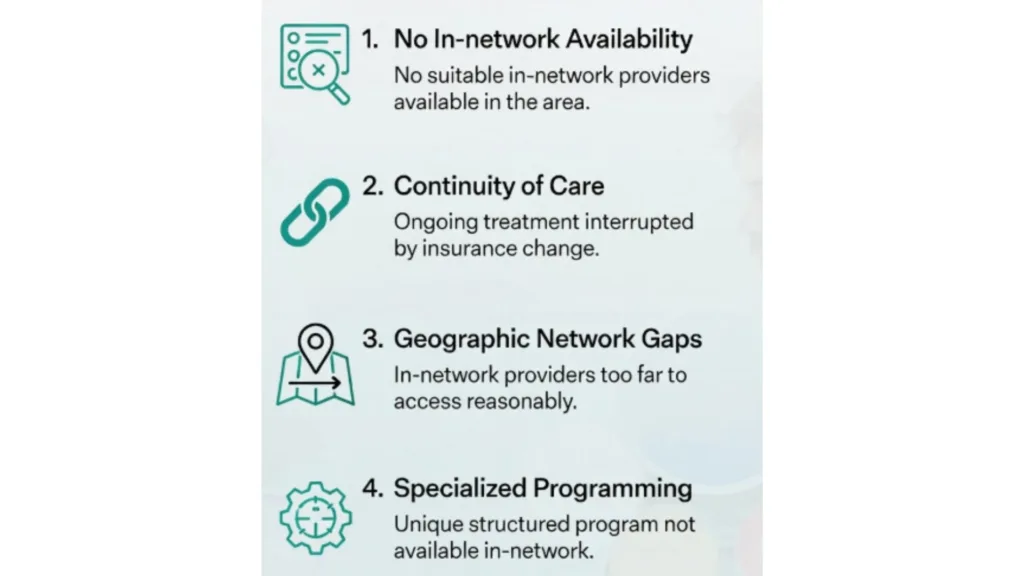
Not every out-of-network situation justifies an SCA. However, certain scenarios that align with recognized exception categories strengthen your case.
1. No In-network Availability
An SCA is appropriate when there is no in-network provider that offers the required level of care in their area. Patients should document outreach to in-network providers to prove that they are unable to provide the needed services. This makes out-of-network care necessary.
2. Continuity of Care
Progress depends on a deep understanding of the patient’s history in ongoing treatment. If a patient’s insurance changes during an active course of care, requesting an SCA helps preserve continuity. Treatment continues uninterrupted with the current provider, safeguarding the gains already made.
3. Geographic Network Gaps
An SCA may be appropriate when distance makes in-network care inaccessible, especially in underserved areas where the nearest qualified provider is beyond a reasonable travel range. Payers approve an SCA to allow treatment with a closer out-of-network provider at in-network cost-sharing levels. Granting that exception ensures patients don’t forgo treatment due to distance.
4. Specialized Programming
SCAs are justified when patients require a structured program that is not available in-network. When an out-of-network provider offers the exact level and type of BH programming the patient needs, requesting an SCA grants access to appropriate care at the right time.
How to Initiate The SCA Process
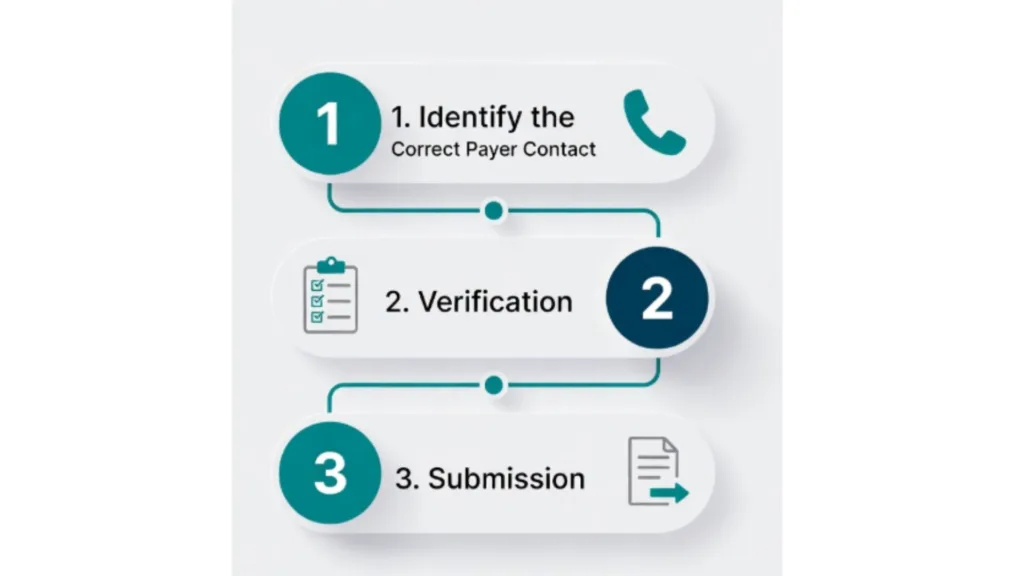
There’s no standardized pathway for submitting an SCA request. Each payer manages the process differently, and requirements vary by insurer, plan type, and whether the plan is fully insured or self-funded.
The steps below assume your admissions or payer relations team is driving the process, which, in nearly every BH setting, they should be.
1. Identify the Correct Payer Contact
Start by calling the provider services line on the back of the member’s insurance card, not member services.
Provider services connects you to the network management or care coordination team that actually handles SCAs. If your admissions coordinator can’t get to the right department, ask the patient to make a parallel call to member services to request a network exception. Payers sometimes route faster when the request comes from both sides.
When you reach the right contact, confirm:
- Whether SCAs or network exceptions are available under this specific plan
- Which in-network providers offer the required level of care within a reasonable radius
- Current wait times and appointment availability at those in-network options
- Whether the plan is fully insured or self-funded, since this changes who has authority to approve
- The exact submission channel, required forms, and decision timeline
Document the name, direct number, and email of every payer contact you reach. This becomes the foundation of your payer contact database.
2. Verification
Run two verifications in parallel.
- On the benefits side, your VOB team confirms active coverage, out-of-network benefits, deductible and out-of-pocket status, any pre-authorization requirements, and whether the plan is ERISA-governed. For self-funded plans, identify the plan sponsor and TPA. They often have more flexibility than the insurer’s standard SCA desk suggests.
- On the clinical side, your utilization review team prepares the medical necessity case using ASAM or LOCUS criteria, DSM-5 diagnoses, and documentation of why a lower level of care or an in-network alternative isn’t clinically appropriate.
Completing both tracks before submission prevents the back-and-forth that stalls most SCAs in the first 72 hours.
3. Submission
Build a complete SCA request package and submit through the payer’s designated channel, usually a secure portal, dedicated fax line, or network management email. A complete package signals clinical seriousness and administrative readiness, and it shortens decision time substantially.
A strong package includes:
- Member ID and full benefit plan details
- Formal SCA request letter on facility letterhead, signed by the billing or payer relations lead
- Out-of-network provider information: facility name, NPI, tax ID, credentials, accreditations (Joint Commission, CARF), and state licensure
- Relevant CPT and revenue codes for the proposed level of care
- Proposed start date, anticipated length of stay or session count, and level of care
- Signed patient consent and HIPAA authorization
- Clinical justification packet, including DSM-5 diagnoses, ASAM or LOCUS criteria, recent assessments, and documentation of failed lower levels of care where applicable
- Documented evidence of in-network search: providers contacted, dates, and barriers encountered (no availability, geographic distance, lack of specialty match)
Submit a single complete package rather than a partial request followed by supplements. Partial submissions get queued, deprioritized, and frequently lost between reviewers.
How to Negotiate Stronger Reimbursement Rates on Single Case Agreements
Insurers often begin with a “pay at the highest in-network rate” offer, meaning you bill as an in-network provider and the patient is responsible only for standard in-network cost-sharing. While this is a common starting point, it’s rarely the ceiling. With strong clinical justification and market context, you can push beyond standard in-network rates and secure reimbursement that approaches your usual and customary fees.
1. Know Your Numbers Before the Call
Walk into every rate conversation with three numbers ready:
- Your usual and customary rate for the level of care, by CPT or revenue code
- The payer’s published in-network rate for the same codes (request the fee schedule in advance)
- Your floor, which is the minimum rate at which the case is still operationally viable given your cost per patient day or per session
Without these three numbers, you’re negotiating blind. With them, you can anchor confidently and recognize a low offer immediately.
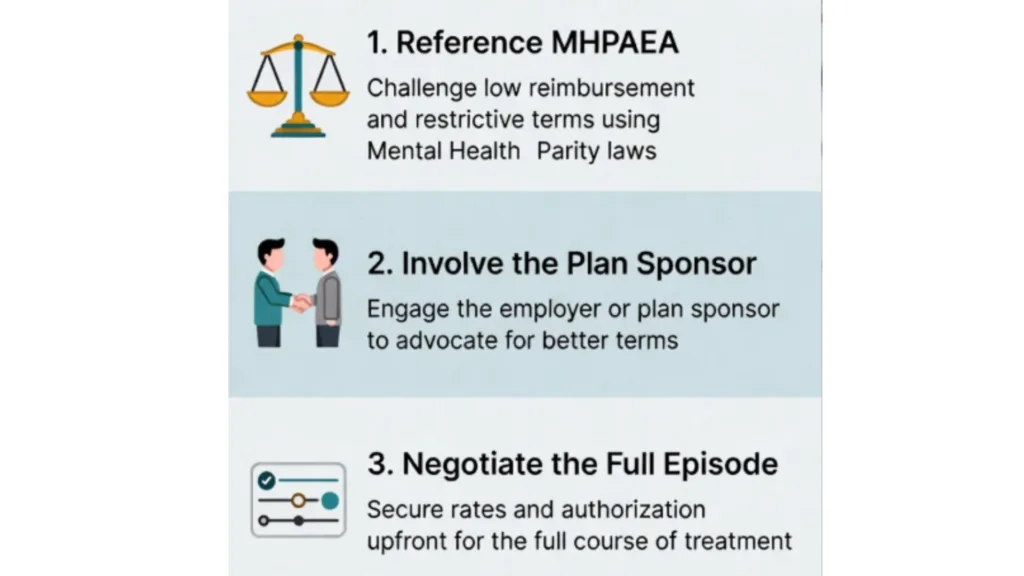
2. Reference the Mental Health Parity and Addiction Equity Act
Invoking MHPAEA lets you challenge low reimbursement offers or restrictive terms by positioning them as parity concerns. If a payer routinely approves higher out-of-network rates for medical or surgical cases but takes a more restrictive approach with behavioral health, that discrepancy is worth highlighting.
The same logic applies to delays in authorization, excessive utilization review, or rates that don’t reflect the intensity of care. Support your position with concrete comparisons: how does the payer reimburse out-of-network medical services of similar acuity, and how does that compare to their SCA offer for your level of care? You don’t need to threaten a parity complaint to get the point across. Naming the framework usually shifts the conversation.
3. Negotiate by Level of Care, Not a Blended Rate
Payers often propose a single blended rate to simplify the agreement. Resist this. Detox, residential, PHP, IOP, and outpatient have different cost structures and clinical intensity, and a blended rate almost always favors the payer. Negotiate each level separately so step-downs in care don’t quietly erode your margin.
4. Negotiate the Full Episode
Securing rates and authorization upfront for the full treatment plan reduces financial uncertainty. It limits the need for repeated reauthorizations, concurrent reviews, and mid-treatment renegotiations that can delay payment.
Propose a bundled case rate or a tiered structure that reflects differences in intensity over time. Reinforce your request with a detailed treatment plan, historical length-of-stay data, and outcomes benchmarks. This demonstrates that your pricing is thoughtful, not opportunistic, and it makes it easier for the payer to say yes.
5. Build in an Escalator
For SCAs that span more than a few months, request an annual escalator of 3 to 5%. Payers grant these more often than providers ask. Without an escalator, your negotiated rate erodes against rising costs the longer the agreement runs.
6. Involve the Plan Sponsor When Stuck
The plan sponsor ultimately carries the financial risk and, with it, the authority to influence exceptions. Bring them into the conversation when you encounter delays, low reimbursement offers, or denials that could disrupt care.
You can engage the plan sponsor through the member, through HR, or through a case manager. Plan sponsors are highly attuned to employee well-being and are more likely than the insurer to advocate for reasonable SCA terms when an employee’s care is at risk.
7. Get Everything in Writing Before Services Start
Verbal rate agreements get re-interpreted at claims processing. Before admission, secure:
- The negotiated rate sheet by CPT or revenue code
- Authorized units or days of service
- Effective and expiration dates of the agreement
- The authorization number tied to the SCA
- Payer contact for concurrent review and reauthorization
If any of these are missing, the agreement isn’t ready to operationalize.
SCA Timelines
SCA timelines vary based on payer responsiveness, plan type, and how complete your submission is on day one. Standard expectations:
- 24 to 48 hours from submission to payer acknowledgment that the request is in queue
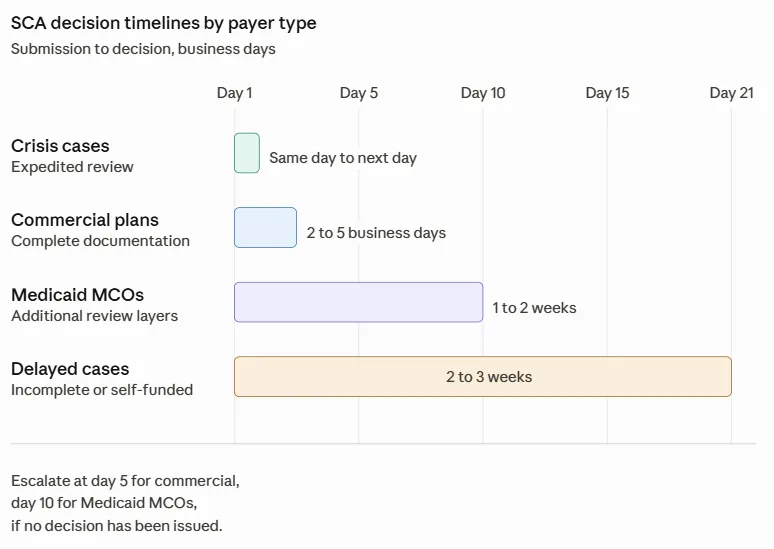
- 2 to 5 business days for a decision on commercial plans with complete documentation
- 1 to 2 weeks for managed Medicaid and MCO plans, which carry additional layers of review
- Same day or next business day for crisis cases when you flag them as expedited and provide active risk documentation (suicidal ideation, active withdrawal, recent overdose, acute psychiatric instability)
Delays of 2 to 3 weeks are common when documentation is incomplete, when the plan is self-funded and the TPA has to route to the plan sponsor, or when the payer’s SCA desk is backlogged. Build these scenarios into your admissions planning rather than treating them as exceptions.
Setting Internal SLAs
Your team controls more of the timeline than payers do. Set internal service-level expectations and hold them:
- Initial payer outreach within 4 business hours of identifying an out-of-network admission
- Complete submission package within 24 hours of confirming the SCA pathway
- Follow-up cadence of every 48 hours after submission until the payer responds
- Escalation to a network manager or supervisor at day 5 for commercial, day 10 for Medicaid MCOs
Track time-to-acknowledgement and time-to-decision by payer in your SCA pipeline. After 30 to 60 days of data, you’ll see which payers consistently miss their own published timelines, and you can use that pattern as leverage in future negotiations or escalations.
When to Escalate
If the payer misses their own published decision window, escalate. Three escalation paths work:
- Up the payer chain. Request the network manager’s supervisor or the medical director assigned to the case. Reference the original submission date and the payer’s stated turnaround.
- To the plan sponsor. For self-funded ERISA plans, the employer carries the financial risk. A call from HR or a benefits manager often unsticks a stalled request within 24 hours.
- Through state regulators. For fully insured plans, state insurance commissioners and Medicaid ombudsman offices accept complaints about parity violations and unreasonable delays. The threat of a complaint frequently moves a case before the complaint is actually filed.
Document every escalation in the case file. If the SCA is ultimately denied or underpaid, this paper trail supports your appeal.
Common Single Case Agreement Pitfalls That Cost BH Providers Revenue
Even with a strong SCA request, many BH providers still lose revenue or face delays due to avoidable errors. We’ll discuss the most costly mistakes to avoid when negotiating and executing SCAs and how to prevent them.
1. Admitting Before an SCA is Executed
Once services begin without a signed SCA, the payer will treat the case as standard out-of-network care. Reimbursement automatically defaults to their out-of-network rates, which are always below negotiated SCA levels.
The claim may even be denied due to a lack of a valid agreement at the time of service. These denials are difficult to overturn because the payer can state that no contract was in place. To protect reimbursement, initiate admission after SCA is executed and signed by the payer.
2. Submitting an Incomplete Package
Incomplete documentation derails an SCA. Payers usually flag such submissions, stalling the request in the queue. Even a missing member ID or an unsigned consent form can push the process back by days or more. Ensure every submission follows a standardized behavioral health checklist without exception. It forces the payer to engage on the merits of the request.
3. Accepting the First-rate Offer
Accepting a first-rate offer that feels like a short-term win can quickly become a liability as operating costs increase.
Shift the dynamic by leading the negotiation. Anchor with your rate to increase your behavioral health collections. Follow these practical ways to stay in control:
- Request the payer’s fee schedule in advance so you’re not evaluating numbers on the spot.
- Negotiate rates by level of care rather than accepting a single blended rate.
- Include an annual escalator, such as 3–5%, to account for rising costs.
- Ensure the final rate sheet is documented in writing before your team proceeds
You’ll not only protect your margins but also your ability to deliver consistent, high-quality care.
Streamlining SCA Workflows for Admissions Teams
When SCA management is streamlined, teams secure stronger reimbursement outcomes. Adopt this repeatable workflow as part of your admissions process.
1. Build a Payer Contact Database
A strong payer contact database helps teams move faster. Map every payer you work with, whether commercial plans, Medicaid MCOs, Medicare Advantage, or third-party administrators.
For each contact, capture actionable details in a CRM, shared database, or structured spreadsheet:
- Payer name and plan type
- Department
- Contact role
- Direct contact information
- SCA submission method
- Required documentation
Assign a designated person or team to maintain, update, and validate the data. Your workflow will stay accurate over time.
2. Templatize Submission Packages
Intake coordinators focus on patient-specific details and the clinical summary to speed up submissions. So standardize your SCA submission process with payer-specific request letter templates that are pre-populated with your facility’s information.
Every component of the package should answer these three questions that the reviewer is asking:
- Does this patient require this level of care?
- Is this the appropriate setting?
- Why can’t the patient be treated at a lower level of care?
If your documentation doesn’t address all three, you’re increasing the likelihood of a denial.
3. Designate SCA Ownership
Defining ownership means assigning accountability at every stage of the SCA lifecycle so nothing falls through the cracks.
Start with a single point of accountability, typically an SCA coordinator, payer relations specialist, or managed care lead. This role owns the outcome from initiation through execution, ensuring the process moves forward.
From there, assign stage-based responsibilities to prevent bottlenecks:
- Admissions or intake teams identify and flag out-of-network cases, triggering the SCA process.
- The SCA owner leads payer outreach, submission, and negotiation.
- Clinical or utilization review teams provide the medical necessity documentation
- The billing team ensures alignment with approved rates and terms before claims go out.
Set clear service-level expectations beforehand. For instance, payer contact within 24 hours, consistent follow-ups every 48 hours, and timely escalation when responses stall.
4. Track SCA Pipeline and Outcomes
Just like health billing KPIs, every SCA should be tracked from start to finish, from submission date to final execution. This is how you identify which payers move quickly, where deals stall, and how to strengthen future negotiations.
Structure your SCA into clear stages:
- Identified
- Submitted
- In Negotiation
- Approved
- Executed
- Closed with entry and exit criteria for each.
Capture each case using standardized data fields: payer details, level of care, admission timelines, requested vs. approved rates, assigned owner, and timestamps at every stage. With consistent data, you can spot trends, measure performance, and uncover inefficiencies.
Finally, document whether each SCA was approved, denied, underpaid, or expired, and why. These insights help refine submissions, sharpen negotiation strategies, and improve payer engagement.
5. Audit Claims Against Executed SCAs
Without a structured audit process, underpayments and errors can quietly erode revenue. Auditing claims ensures that negotiated terms translate into correct reimbursement. The process requires a reliable system to store and access key agreement details:
- Authorized services.
- Negotiated rates.
- Billing codes.
- Service dates, etc.
Standardize the audit process with clear checkpoints. Compare expected vs. actual reimbursement, flag variances, and categorize discrepancies such as rate mismatches, partial payments, or denials. And if any issues arise, follow up with the payer or submit formal appeals.
The Prosperity Advantage in SCA Negotiations
Prosperity partners with behavioral health providers to build the infrastructure that turns SCAs from a reactive scramble into a repeatable revenue process.
Our payer relationship management and contracting teams handle SCA outreach, submission, and rate negotiation directly with payers. Our utilization review team builds the clinical justification packages that get SCAs approved on the first submission. And our intelligent workflow tools track every SCA through the pipeline so admissions, UR, and billing stay aligned in real time.
Over time, consistent SCA execution builds payer trust. Many of our clients find that these one-off agreements evolve into in-network contracting opportunities, turning SCAs into the entry point for long-term payer relationships that strengthen financial performance.Contact us today to start building more consistent, higher-value SCA outcomes and stronger payer relationships.