
Quick Summary
Behavioral health collections sometimes drop regardless of patient volume, usually due to delayed or denied insurance claims, incomplete paperwork, and unpaid patient balances. Implementing a standard credentialing and billing process, coupled with proactive claims management, benefit verification, and patient payment tracking, ensures that revenue reaches the practice.
How Behavioral Health Collections Affect Revenue
A constant stream of patients doesn’t always translate to increased revenue. Despite high numbers, your behavioral health practice can still experience stagnant income, stunted financial growth, or even losses.
Without a clear collections process, revenue leaks through denied claims, missed follow-ups, and uncollected patient balances. And without measurable profit, plans for expansion, improved treatments, or providing more in-depth services halt.
The good news is that most collection problems come down to process, not patient volume. This guide outlines practical steps that can strengthen your collections process and improve overall financial performance.
Why Listen to Us?

Prosperity boasts hands-on behavioural health expertise in compliance and billing, offering accurate, real-time analytics to help you identify missing revenue and increase collections. Our clients capture nearly all collectible revenue and streamline credentialing with a 90% first-pass rate, so billing and reimbursements aren’t a headache.
What Are Behavioral Health Collections?
Behavioral health collections are the actual payments your practice receives for providing healthcare. They make up all the income in your bank account after you’re paid for your services.
Generally, collections come from any or both of these two places:
- Insurance payments for covered services
- Patient payments like copays, deductibles, or self-pay balances
It’s important to note that collections don’t include bills that haven’t officially been reimbursed. When a claim gets denied, delayed, underpaid, or never followed up on, that revenue isn’t collected, even if a clinician attended to the patient.
Why Do Behavioral Health Collections Drop?
When you have a steady inflow of patients, but your revenue doesn’t correspond with these numbers, it signals reduced collections. To help you identify where your revenue is leaking, we’ll cover the top reasons behavioral health collections drop below:
1. Denied or Delayed Claims
An Akasa survey showed 76% of leaders citing denials management as the most time-consuming revenue cycle task, showing how common this issue is.
Insurers have strict credentialing and billing requirements that organizations must meet before they receive payments. Any discrepancies in your CAQH profile, names, addresses, coding, or authorizations can result in rejections or delays. Even a single mismatched provider name between your NPI record and claim submission can trigger a denial that takes weeks to resolve.
2. Approval Gaps
If a provider hasn’t been officially approved by the insurer, any bills or claims will be considered out-of-network or automatically rejected. Billing before your given effective date also triggers denials, sometimes even after credentialing approval. When that happens, services go unpaid, cash flow slows, and collections take a direct hit.
3. Poor Benefit Verification
Insurance benefits differ depending on the patient’s plan. Failing to confirm their coverage details before administering services could make providers render treatments that aren’t covered or exceed stated limits. A patient’s plan might cap IOP sessions at 20 per year or exclude telehealth entirely. Without verifying this upfront, insurers don’t reimburse those services, and you absorb the loss.
4. Weak Follow-Up
Claims can be missed or lost in payers’ systems. Consistent follow-ups help insurers keep track of providers’ bills and ensure reimbursements, or provide timely feedback when errors occur. Unpaid claims that aren’t tracked and appealed quickly often age past the filing deadline and become permanently lost revenue.
5. Uncollected Patient Balances
Some patients pay out of pocket or have insurance plans that require them to pay copays or standard amounts. When these balances are frequently left unpaid, they quietly chip away at overall collections.
A practice seeing 200 patients per month with an average $30 copay leaves $6,000/month on the table if collection isn’t consistent.
How to Increase Behavioral Health Collections
To improve collections, you must take actionable steps to fix gaps and maintain profitability. Here are ten straightforward ways you can increase your behavioral health collections for stronger revenue:
1. Review Fee Schedules
Fee schedules are the list of rates your insurer has agreed to reimburse you for each service. These rates should be competitive and reflect your market value and geographical area.
If you agree to outdated amounts that fall below industry rates or don’t align with your overhead costs, your revenue will decline despite paid claims. A simple 2% increase on your most billed service can increase your revenue significantly without adding new patients.
Evaluate your fee schedule with the following tips:
- Compare rates against your highest-volume CPT codes.
- Benchmark rates against regional averages when possible.
- Audit for underpayments by comparing what was billed, what the contract allows, and what was actually paid.
- Request renegotiation if your fee schedule falls short compared to market rates.
2. Verify Benefits Before Service
Not all plans cover every behavioral health service. Different insurers have their unique coverage arrangements and benefits, and assuming similarities can lead to missed revenue.
Before a patient walks into their session, check with their insurer to answer these questions:
- Is their insurance currently active? Expired or changed plans hinder claim approvals.
- Does their plan cover the requested service? Every plan has its specific coverage. Some limit the number of sessions allowed for a service per year. Others may require additional sign-offs. Always confirm covered services to prevent claim denials.
- How much does the patient owe? Insurance doesn’t always cover 100%. Patients may owe a copay, a deductible, or a previously-agreed percentage. Know how much to bill the insurer and what amount the patient is expected to cover.
3. Proper Claim Submission
The faster you bill payers after seeing a patient, the faster your money comes in. Delaying claim submission equally delays revenue and puts you at risk of missing payer deadlines. Send in your claims within 24-48 hours to maintain smooth cash flow and reduce operational backlog.
However, while emphasizing speed, prioritize sending a clean claim so that insurers can begin processing instantly without returning it for corrections. Errors in patient data and claim submissions are one of the most common causes of failed reimbursements.
A survey from Experian Health backs this, with 68% of respondents saying that inaccurate data drives denials. Well-written claims are more likely to have a first-time pass rate and prompt faster reimbursement.
A standard claim should have:
- Matching provider information such as names, addresses, NPI number, and Tax ID.
- Accurate date of service, time billed, and units.
- Correct CPT code. For example, 90834 stands for 45-minute individual psychotherapy, while 90837 represents 60-minute individual psychotherapy.
- Accurate ICD-10 diagnosis code explaining why the service was medically necessary.
- Proper modifiers for extra detail about delivery modes, such as telehealth.
- Detailed notes and treatment plans.
Missing any of these elements causes the payer to reject, deny, or underpay your claim, affecting your collections.
4. Strengthen Clinical Documentation
Claim denials aren’t always a billing problem. Often, the issue starts in the clinical note. If a progress note doesn’t clearly demonstrate medical necessity, the payer will reject the claim regardless of whether the CPT code and patient data are correct.
Every note should support the service billed. That means:
- Documenting exact start and stop times for time-based codes (a 90837 requires at least 53 minutes of psychotherapy, and the note needs to reflect that).
- Showing a clear link between the diagnosis, the intervention used, and the patient’s response.
- Using structured note formats like SOAP or DAP to maintain consistency across clinicians.
- Avoiding vague language. “Patient discussed feelings” doesn’t establish medical necessity. “Patient reported increased suicidal ideation following job loss; clinician conducted safety assessment and updated safety plan” does.
Train clinicians to understand that their documentation directly affects whether the practice gets paid. When notes are incomplete or generic, claims get denied, and appeals require even more documentation after the fact.
5. Monitor Accounts Receivable (AR) Aging
Your Accounts Receivable (AR) is income that is still owed. For a behavioral health practice, this includes submitted insurance claims that haven’t been paid and outstanding patient balances.
With AR aging, you keep track of how long your money stays unpaid. Prepare an AR aging report, grouping your unpaid balances into these categories:
- 0-30 days: Normal delay from recently-billed claims.
- 31-60 days: Slight delay but still within regular range.
- 61-90 days: Delay is now concerning and should be attended to urgently.
- 91+ days: Extensive delay with higher risk of non-payment.
In a healthy report, most AR should sit under 90 days. Monitoring your revenue in this way shows you how quickly your payers process your claims and whether cash flows in your practice.
It also shows when you need stronger strategies for increasing collections. For instance, if most AR is over 90 days, it indicates that urgent follow-ups and payer tracking are necessary.
6. Collect Patient Balances Upfront
After conducting Verification of Benefits (VOB), communicate any patient balances at their appointment to avoid dragging out revenue. Requesting payment later makes your bill seem less urgent and reduces the chances that you’ll get paid immediately.
A few tips to improve balance collection include:
- Communicate estimated costs to patients clearly and on time.
- Establish copay collection at check-in as standard policy and train staff to handle it accordingly.
- Offer easy, digital options such as online portals or card-on-file for fast, frictionless payment.
7. Tighten Authorization Processes
In behavioral health, providers must have additional approval from the insurer to administer higher levels of care, such as Intensive Outpatient Programs (IOP) or Partial Hospitalization (PHP).
Skipping this step completely or providing more care than the insurer approved can prompt claim denials, which further drains revenue.
Some tips to manage this include:
- Track authorizations by patient and date.
- Monitor expiration timelines and begin the renewal process on time. A lapsed authorization mid-treatment means every session after expiration gets denied.
- Ensure the provided treatment aligns with approved levels of care.
8. Replace Reactive Billing with Structure
Revenue drops when billing becomes reactive or scattered. A clear system combined with smart automation keeps claims and patient balances moving seamlessly without disrupting your entire workflow.
Managing collections proactively makes your cash flow more predictable and reduces the time you spend chasing payments, letting your staff work more efficiently. Here are a few ways to implement this:
- Assign clear ownership for each step of the revenue cycle.
- Use dashboards or automated alerts for pending claims, denials, and expiring authorizations.
- Automate patient payment reminders via email or text.
- Schedule regular check-ins (weekly or biweekly) to review revenue metrics and flag aging claims before they become write-offs.
9. Build a Denial Management Process
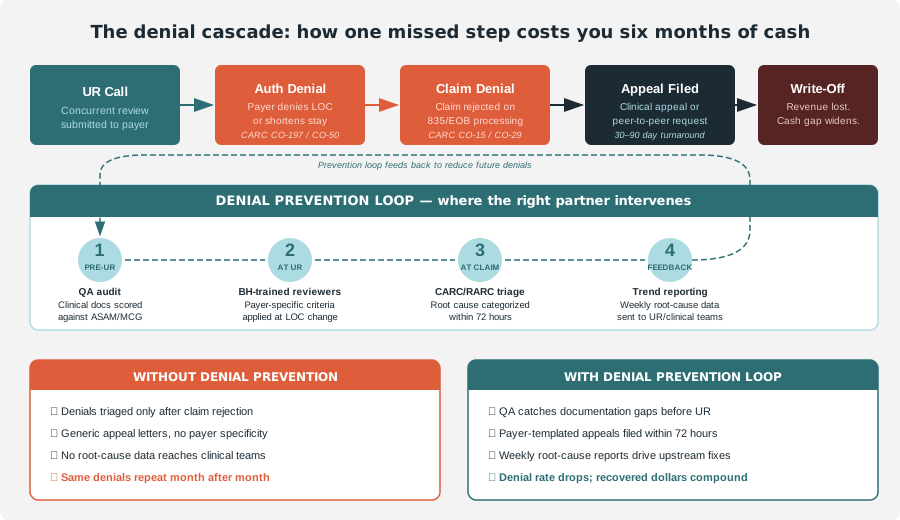
Most practices treat denials as one-off problems. A claim gets rejected, someone reworks it, and the cycle repeats. This is reactive, and it leaves money on the table every month.
Instead, treat denial management as a system:
- Track denial reasons by category. Group them into buckets: eligibility issues, authorization failures, coding errors, documentation gaps, timely filing. This tells you where the real problems are.
- Build appeal templates. For your most common denial types, create standardized appeal letters with the supporting documentation payers typically request. This cuts turnaround time significantly.
- Run root cause analysis monthly. If 30% of your denials come from expired authorizations, that’s not a billing problem. It’s a workflow problem upstream. Fix the process, not just the individual claim.
- Set deadlines for appeals. Most payers have filing windows for appeals (often 30-90 days). Track these the same way you track initial claim deadlines.
The goal is to stop the same denials from recurring. A practice that reduces its denial rate from 10% to 5% recovers thousands in revenue monthly without seeing a single additional patient.
10. Get Expert Help
Behavioral health billing services and collection is a niche, specialized skill, and even organized practices can hit limits due to a lack of expertise. When you’re dealing with constant denials, aging AR, slow cash flow, and a staff that’s stretched thin, external help becomes imperative.
While choosing a partner, look for solutions that go beyond basic billing, offering behavioral health expertise, technology, and proactive performance management. This is where Prosperity shines.
Prosperity is an all-in-one revenue cycle management platform built to optimize behavioral health collections from start to finish.
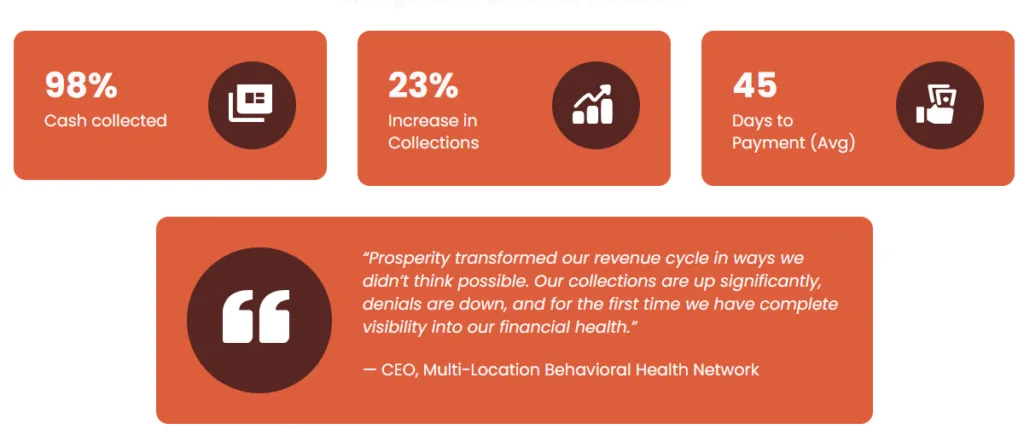
Our results speak for themselves: clients see 98% of collectible revenue captured, first-pass payment rates over 90%, and 75% of AR under 90 days. With Prosperity, your claims are paid in as little as under 45 days for commercial insurers and 30 days for Medicaid, so you can enjoy higher utilization review, consistent cash flow, and increased productivity.
Higher Collections, Stronger Performance
More patients don’t fix collection problems. Better processes do. When billing, authorizations, and follow-ups run with structure, revenue drainage stops and collections improve. Increased collections mean healthier AR, cash flow for better planning, and targeted growth. Build a revenue collection process that works for you. Contact Prosperity to turn poor collections into trusted financial performance with ease.