

Quick Summary
Slow VOB turnaround loses patients and revenue. Speed it up by building payer-specific forms, prepping before calls, using electronic verification for baseline data, asking behavioral health-specific questions, batching verifications, re-verifying during treatment, and tracking metrics.
Why VOB Speed Can Make or Break Behavioral Health Admissions
Behavioral health deals with immediate crises. Calls come in at all hours from patients who need help now. A slow VOB process can close the window of opportunity before a patient ever walks through your door—they’ll go to whoever can verify fastest.
Speed also affects your bottom line. If billing runs a week behind and a VOB wasn’t done properly, you might deliver care without valid benefits. That’s thousands per patient you’ll never recover.
Most behavioral health VOBs can be completed in 45-90 minutes during normal business hours. If yours regularly stretch into hours or days, the seven strategies covered in this Prosperity guide will help.
Why Listen to Us
Prosperity manages revenue cycle operations for behavioral health providers ranging from single-site outpatient practices to multi-facility residential programs. Our clients consistently hit 98% cash collection rates and under 45 days to payment on commercial claims.

We verify benefits daily across every level of care, so we know exactly where VOB processes break down and how to fix them.
What Is VOB Turnaround Time?
VOB turnaround time measures how long it takes from receiving a patient inquiry to having complete, verified insurance information. This includes confirming the policy is active, understanding what’s covered for behavioral health specifically, identifying deductibles and out-of-pocket costs, and flagging any authorization requirements.
In behavioral health, “complete” verification goes beyond basic eligibility. You need to know:
- Whether benefits are carved out to a separate administrator
- What levels of care are covered
- Session limits
- Which clinical criteria the payer uses for medical necessity
Missing any of these details creates claim denials downstream.
Industry benchmarks suggest 45-60 minutes for a thorough behavioral health VOB. If you’re consistently exceeding that, you likely have process problems worth fixing.
Common VOB Mistakes That Slow You Down
Before diving into solutions, it helps to know what’s breaking. These are the VOB errors we see most often when providers come to us with revenue cycle problems:
- Verifying medical benefits instead of behavioral health benefits. Many plans carve out behavioral health to a separate administrator like Optum or Magellan. If you verify through the main insurance line, you’ll get medical benefits that don’t apply to your services. The claim denies, and you’re back on the phone figuring out what went wrong.
- Trusting portal data without phone verification. Electronic eligibility checks are fast, but they don’t capture behavioral health nuances. Session limits, level-of-care restrictions, and prior auth requirements often don’t appear in standard 270/271 responses. Portal says the patient is covered; claim gets denied for missing authorization.
- Not documenting for appeals. When a payer denies a claim and you need to prove what their rep told you during verification, “I think they said it was covered” doesn’t cut it. No reference number, no rep name, no timestamp means no leverage.
- Skipping re-verification during long stays. A patient admitted in November with great benefits might have a termed policy by January when their employer changes plans. You don’t find out until the claim denies for services rendered to an ineligible member.
- Using the same form for every payer. Blue Cross asks different questions than Aetna. Medicaid has different requirements than commercial. A generic checklist misses payer-specific details that matter for reimbursement.
Most of these mistakes stem from treating behavioral health VOB like general medical verification. It’s not. The fixes below address each of these problems directly.
How to Improve VOB Turnaround Time
1. Build Payer-Specific VOB Forms
The biggest drain on turnaround time is using generic checklists. Different insurers have different stipulations, variations, and requirements. A one-size-fits-all VOB form won’t cut it.
Build separate forms for your high-volume payers that include the exact questions each one requires. Every form should capture:
- Representative’s name and reference number (essential for appeals)
- Policy status and effective dates
- Deductible and out-of-pocket amounts
- Behavioral health-specific benefits
- Prior authorization requirements by level of care
- Session limits
- In-network vs. out-of-network differences
This takes time upfront but pays off immediately. Staff stop guessing which questions to ask, new hires get up to speed faster, and you catch red-flag policies before they become write-offs.
2. Prepare Before You Call
Manual VOB calls can take 60+ minutes if you’re not ready. Mid-call scrambling and multiple callbacks kill your turnaround time.
Before dialing, have these items in front of you: front and back of the patient’s insurance card, patient demographics and date of birth, anticipated level of care, and CPT codes for planned services. This prep work takes two minutes and can shave 15-20 minutes off each call.
3. Use Electronic Verification First
Phone verification is the biggest bottleneck. Insurance hold times vary wildly, and complex questions often require escalation to supervisors. One verification can eat an hour of staff time.
Many eligibility details can be pulled instantly through payer portals or clearinghouse tools. Use electronic verification to gather baseline data like policy status, deductible amounts, and primary vs. secondary coverage. Then use phone verification only for behavioral health-specific questions that portals don’t answer reliably. You’re not wasting 20 minutes on hold just to confirm the policy is active when you already pulled that data electronically.
4. Ask Behavioral Health-Specific Questions
Standard eligibility checks miss nuances that kill behavioral health claims later. Generic questions get generic answers.
The problem is that behavioral health benefits often work differently than medical benefits. They might be carved out to a separate administrator entirely. They might have session limits that don’t appear in a standard eligibility response. They might require specific clinical criteria like ASAM for substance use or InterQual for mental health.
Make sure you’re asking:
- Are behavioral health benefits carved out to a separate administrator?
- What’s covered for detox, residential, PHP, IOP, and outpatient specifically?
- Is prior auth required, and how many days are typically approved initially?
- What clinical criteria does the payer use for medical necessity?
- Are there substance-specific exclusions or lifetime limits?
Treat every VOB like you’ll need it for a payment appeal later. Record the representative’s name, reference number, date, and time of call. Note exact responses to key questions. This takes an extra minute during the call but saves hours fighting denied claims.
5. Batch Your Verifications
If you’re verifying one patient at a time as calls come in, you’re inefficient. Context-switching between VOBs and other tasks drains productivity.
Schedule dedicated verification windows where staff work through multiple VOBs back-to-back. Some practices run overnight batch processing for the next day’s scheduled admissions so staff arrive to a color-coded report showing eligibility status.
They only pick up the phone for exceptions. For high-volume facilities, consider dedicated VOB staff who do nothing but verifications during peak hours.
6. Re-Verify During Treatment
Initial VOB isn’t enough for behavioral health. Treatment episodes can span weeks or months. Benefits change, policies lapse, and deductibles reset mid-stay.
Set up ongoing verification at regular intervals:
- Weekly for residential and inpatient stays
- At benefit plan renewal dates (often January 1)
- When transitioning between levels of care
- Before any high-cost services
Catching a termed policy mid-stay beats finding out when the claim denies. Providers who re-verify weekly often catch at least one coverage change per week.
7. Track Your Metrics
You can’t improve what you don’t measure. Track these VOB metrics monthly:
| Metric | Target |
| Average turnaround time | Under 60 minutes |
| First-call resolution rate | 85%+ |
| Verification errors caught post-admit | Under 5% |
| Denial rate from eligibility issues | Under 3% |
If turnaround time creeps up, dig into whether it’s a staffing issue, a specific payer causing delays, or a process breakdown.
Should You Outsource VOB?
Even with optimized processes, VOB is a resource drain. Every hour your staff spends on hold with insurers is an hour they’re not spending on admissions, patient care, or other revenue-generating activities.
Outsourcing makes sense when your team can’t keep up with inquiry volume, when VOB errors are causing downstream denials, or when you’re losing patients because verification takes too long. The math is straightforward: if a dedicated VOB service costs less than the revenue you’re losing to slow verification and eligibility-related denials, it pays for itself.
Prosperity handles VOB as part of our full-service RCM for behavioral health providers. We use payer-specific workflows built from years of behavioral health billing data, and we verify benefits with the same rigor we’d apply if we were managing your entire revenue cycle.
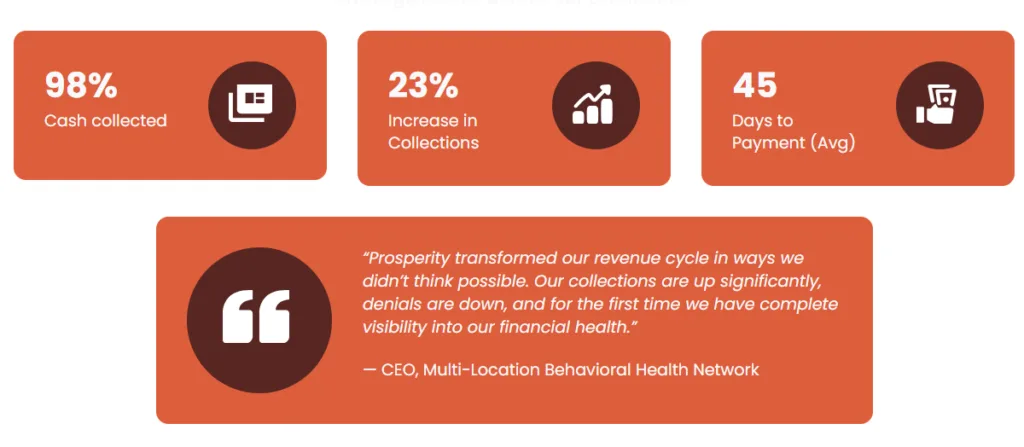
Our clients see first-pass payment rates above 90% and days to payment under 45.
Stop Losing Patients to Slow Verification
Fast VOB turnaround directly impacts patient outcomes and revenue. Patients in crisis can’t wait hours for verification. Claims submitted with incomplete benefit data get denied.If your team is buried in verification calls, missing details, or losing patients to faster competitors, contact our team today.