Quick Summary
PHP represent the highest non-residential level of behavioral health care for individuals who need intensive, structured clinical support but do not require 24-hour inpatient admission. It sits at ASAM Level 2.5 in the continuum of care, one step above IOP, ASAM 2.1 and below residential treatment.
Reduce Denials and Get Paid Reimbursements You Deserve
PHPs deliver high-intensity behavioral health care for SUD and mental health providers. They’re among the most financially risky services to deliver.
Providers routinely lose tens or even hundreds of thousands of dollars annually to claim denials, stalled payments, and recoupments.
Small lapses, vague progress notes, missing treatment plans that don’t demonstrate why PHP is required trigger automatic denials.
This guide breaks down how to overcome these common challenges so you can deliver PHP services with confidence.
Why listen to us?

At Prosperity BH, we specialize in behavioral health revenue cycle management with a deep focus on PHP.
For years, we’ve partnered with treatment centers, CMHCs, and hospitals to recover millions in denied or underpaid PHP claims while building compliant, high-performing billing systems.
We combine real-world clinical understanding with expert medical billing knowledge, giving us rare insight into the care delivery and financial sides of PHP.
2. What Is PHP?
PHP is an intensive, outpatient behavioral health service that delivers hospital-level psychiatric and/or substance use treatment. It’s appropriate for patients who:
- Present acute psychiatric or substance use symptoms that cannot be safely managed in a standard outpatient setting.
- Have recently been discharged from inpatient or residential care and need strong step-down support.
- Cannot maintain safety or therapeutic progress without daily structured clinical contact
This level of care requires a minimum of 6 hours of active clinical programming per day, offered 5 to 7 days a week. The goal is to stabilize symptoms, prevent relapse and help patients successfully transition to lower levels of care. For many patients, successful outcomes in PHP are strengthened by care approaches that build trust through cultural connection and understanding.
From a billing perspective, PHP is reimbursed on a per diem basis. Each day of attendance is billed as a single claim covering all services provided that day.
HCPCS Codes for PHP Billing
H0035 and S0201 are the primary per diem codes for PHP. They bundle most services provided during the program day into a single daily charge.
H0035 – Mental Health Partial Hospitalization
H0035 is the standard billing code for mental health PHPs that provide comprehensive psychiatric care for less than 24 hours per day. Patients attend 4–8+ hours per day, multiple days per week. They engage in individual therapy, group counselling and other vital support services.
S0201 – Intensive Outpatient PHP Services
S0201 is used to bill PHP delivered within 24 hours. It provides intensive, structured outpatient treatment that serves as a vital step-down from inpatient care and requires 5–6+ hours of daily programming. This level of care delivers the depth and intensity of hospital-based treatment while empowering individuals to return home each evening, practice newly learned coping strategies, and gradually reintegrate into daily life.
Claim Form and Revenue Code Requirements
PHP is billed as facility-based outpatient services using the primary claim form, UB-04, also known as CMS-1450. This is the standard institutional claim form used by hospitals, CMHCs, and other facility providers.
UB-04 Claim Form Best Practices
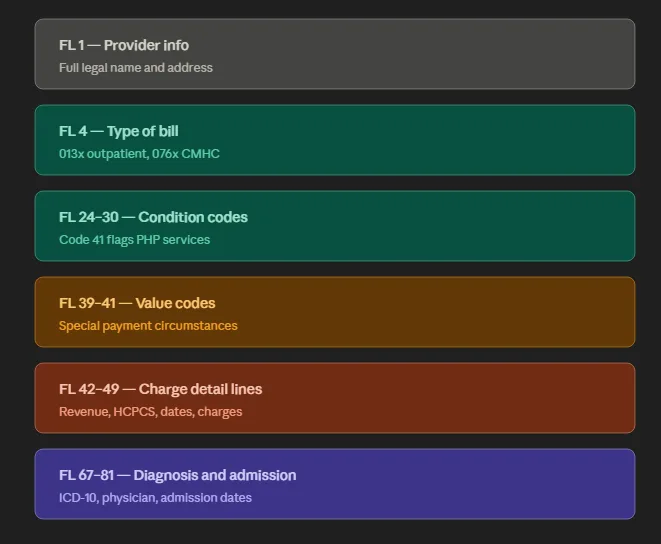
The UB-04 form captures facility-based behavioural health services, ancillary services, and bundled per diem rates. To maximize clean claims, focus on filling these fields correctly:
- Field 1: Indicate the provider’s full legal name and complete address.
- Field 4: For PHP services, include 013x for hospital outpatient and 076x for CMHC.
- Fields 24–30: Code 41 is required for PHP services to signal partial hospitalization.
- Fields 39–41: Capture any special payment circumstances here, such as Medicare deductibles
- Fields 42–49: Enter revenue codes in FL42, the corresponding HCPCS/CPT codes in FL44, and service dates, units, and charges in the following columns.
- Fields 67–81: List the principal and secondary ICD-10 behavioral health diagnoses, attending physician information, and accurate admission/discharge dates.
Key Revenue Codes for PHP
Revenue codes are entered in Field 42 to classify the type of BH care provided and are always paired with a specific HCPCS or CPT code in Field 44 to feature the day’s services.
The primary code is 0912 for less-intensive psychiatric partial hospitalization, ideal for half-day or standard programs. 0913 is for intensive programs that deliver four or more therapeutic services.
Many payers, including Medicare, use the intensity and number of services to determine which code is appropriate.
6. Prior Authorization and Concurrent Review Requirements
When prior authorization and concurrent review are executed thoughtfully, they help control escalating healthcare costs and elevate the overall quality and coordination of care. Let’s discuss them further.
Prior Authorization Best Practices
Commercial insurers, Medicare Advantage plans, and Medicaid managed care organizations require prior authorization before services are administered.
Maintaining up-to-date credentialing is equally important, as many payers require verified provider enrollment before processing authorizations or claims.
That said, PA process involves submitting a request before admission or on the first day. This includes:
- Comprehensive psychosocial/psychiatric assessment.
- Risk assessment, e.g., suicidal ideation without an imminent plan
- Individualized treatment plan with time-limited goals, interventions, and expected duration.
- Evidence of medical necessity. Ex: recent hospitalization or acute destabilization.
- Attendance expectations and patient agreement.
Payers use this information to confirm that PHP is the right level of care and intensive to prevent hospitalization and facilitate behavioral reimbursement.
Concurrent Review: How to Secure Continued Stay Approvals
The core objective of concurrent review is to demonstrate that the patient continues to make progress toward their goals, has clear clinical reasons for slower progress, and still requires the structure of PHP. You must therefore submit fresh documentation every few days to secure extensions.
Strong submissions include:
- Recent progress notes of therapy, daily assessments, and attendance records.
- Updated treatment plan showing progress toward goals or reasons for slow progress.
- Justification for continued intensity, e.g., ongoing symptoms/risks
- Physician involvement, objective metrics, and any changes in condition.
Submitting updates before authorization expires prevents costly retrospective denials.
Common Modifiers for PHP Claims
Modifiers tell payers who delivered the service, in what setting, for which patient population, and under what special circumstances. Here’s how to use modifiers:
- Provider Qualification: They identify the education and licensure level of the rendering provider. Ex: HO for Master’s-level clinician.
- Program / Patient Population Modifiers: They specify the PHP type and the target population being served. Ex: HA for Child/adolescent program.
- HF modifier: This is used with SUD-focused or co-occurring PHPs.
- Telehealth Modifiers: Use 95 for synchronous telemedicine service or GT via interactive audio and video telecommunication.
Placing these correctly signals to the payer that the service aligns with the specialized PHP track, resulting in faster approval and payment.
PHP Reimbursement Benchmarks
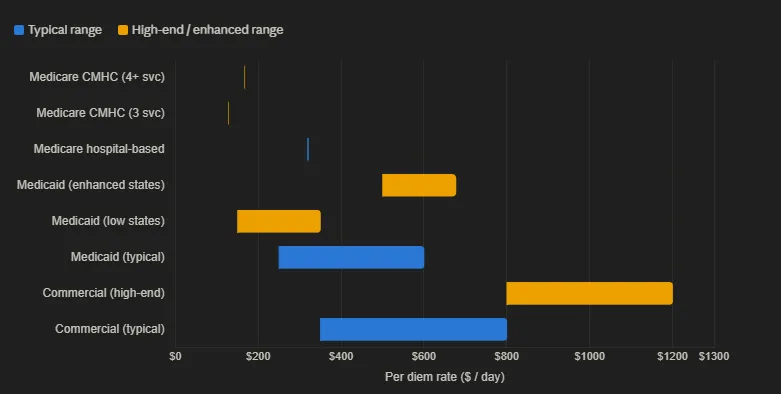
The benchmarks we’ll discuss below represent national averages and realistic ranges for 2025-2026. These figures are drawn from aggregated industry data, payer policies, and recent market analyses.
Commercial Insurance Per Diem Rates
Most commercial per diems fall in the $450–$1,200 range, depending on contract strength, facility credentials, and geographic market. As of 2025–2026 data, typical in-network commercial per diems range from $350–$800 per day, with stronger contracts and higher-acuity programs commonly achieving $600–$1,200+ per day, especially in high-cost regions or with favorable out-of-network arrangements.
Medicaid PHP Reimbursement Rates
Medicaid is the largest payer by volume for BH services, yet it reimburses at the lowest rates. General Medicaid PHP per diem rates fall in the $250–$600+ range per day. Many states hover toward the lower end. Rates can dip as low as $150–$350 per day.
However, several states have implemented recent increases that push rates into the $500–$677+ range in targeted areas.
Medicare PHP Payment Rates
Medicare reimburses PHP services on a per diem basis under the Hospital OPPS. Payments are determined through specific APC codes that vary by provider type and service intensity. For Calendar Year 2026, the national unadjusted per diem rates are as follows:
Hospital-based PHPs receive approximately $319–$321 for APC 5863, 3 services per day. CMHC rates are at approximately $128 for three services per day and $167 for four or more services per day.
Note that these rates are updated annually to reflect the actual costs of delivering mental health care.
Common Denial Triggers
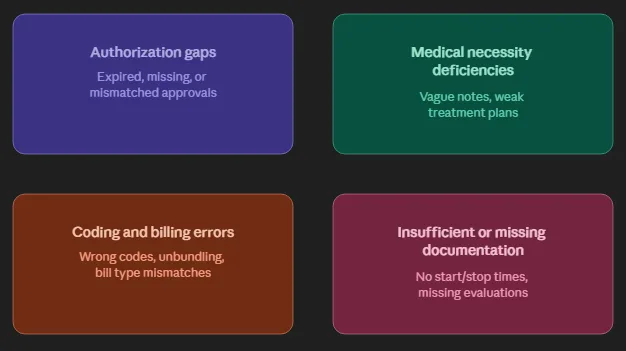
Effective denial prevention and management require strong internal processes and expert support systems. Many providers benefit from hiring behavioral health denial management services to identify the right approach to reducing authorization gaps, medical-necessity issues, and documentation-related recoupments.
Below are the common reasons for claim denials:
1. Authorization Gaps
Lapses in the authorization process can wipe out thousands in reimbursements, sometimes for an entire episode of treatment. Common slip-ups that mess up teams include:
- Starting treatment without securing any authorization.
- Allowing approvals to expire mid-course.
- Delivering services outside the approved dates, times, or units of care.
- Stepping a patient up from outpatient or IOP levels without obtaining fresh authorization for the higher intensity level of care.
Insurers view these problems as high-cost programs that fall into a gray area. As a result, they apply strict authorization rules and never compromise when requirements aren’t met.
2. Medical Necessity Documentation Deficiencies
Payers deny PHP claims when providers can’t demonstrate that PHP is the least restrictive and medically necessary option for the patient. Without strong, individualized evidence, reviewers begin questioning whether a lower level of care could have sufficed.
The most common breakdowns occur in two critical areas. First, clinical notes are often vague or generic. Most lack quantified symptoms, measurable functional impairments, specific risk factors, and a compelling rationale for PHP’s intensity.
Second, documentation frequently misses or contains outdated individualized treatment plans that fail to articulate clear, measurable goals, targeted interventions, and objective evidence of patient progress.
When these elements are weak or absent, clinically appropriate PHP admissions can appear unsupported on paper, leading to denials that could have been avoided.
3. Coding and Billing Errors
Common coding and billing errors quickly trigger denials or compliance issues in BH reimbursements. They include:
- Using the wrong revenue codes or HCPCS codes.
- Accidentally unbundling by billing both a per diem and individual CPT codes on the same day.
- Submitting claims for the wrong level of care, such as billing for PHP when IOP was authorized.
- Missing Condition Code 41 on UB-04 forms for Medicare PHP claims
- Using incorrect bill types, or mismatching time-based psychotherapy codes due to poor session documentation.
4. Insufficient or Missing Documentation
Payers demand compelling proof that the services were delivered, were medically necessary, and met all regulatory and contractual requirements before reimbursing PHP claims.
But too often, providers fall short by maintaining incomplete daily progress notes that lack critical details such as exact start and stop times, the specific therapeutic interventions provided, or the patient’s observable response to treatment.
Even more damaging, entire foundational documents, such as the initial psychiatric evaluation, are frequently missing from the submitted chart.
Without these notes, the records fail to justify the services being billed. For instance, there may be no verifiable evidence that a group therapy session or an individual counselling appointment ever took place, leaving auditors no choice but to deny the claim.
Documentation Standards for Successful PHP Claims
Payers review clinical documents to assess whether services meet PHP requirements. Here’s what to keep track of to back your claims:
- Physician certification: Upon admission, a physician must certify in writing that the patient would require inpatient psychiatric hospitalization if PHP services were not available.
- Initial Psychiatric evaluation: Include the chief complaint, current psychiatric and medical history, mental status exam, and evidence that a lower level of care is insufficient.
- Individualized treatment plan: capture SMART, measurable goals tied to the reason for admission, specific interventions and ongoing discharge planning.
- Progress notes: Every billed service needs a legible, signed, and dated note describing the treatment provided, the patient’s response, and how it connects to the treatment plan goals.
- Continued stay justification: Include regular updates explaining why the patient still requires PHP-level intensity.
How to Maximize PHP Revenue and Minimize Denials
PHP billing offers attractive per-diem rates, but its strict standards put significant revenue at risk if your workflow isn’t built for it.
Many practices face challenges such as expired or missed authorizations, underpaid rates and rejected claims due to incorrect codes.
Such errors cost behavioral health RCM thousands of dollars annually.
Streamlining PHP processes with healthcare automation tools and expert guidance reduces manual errors in authorization tracking, claims scrubbing, and documentation compliance.
Partner with Prosperity BH, a reputable billing specialist, to help you minimize your PHP denials today. Claim our free Revenue Cycle Assessment. We’ll identify gaps in your PHP billing, authorization management, and documentation processes and give you clear insights with no obligation.