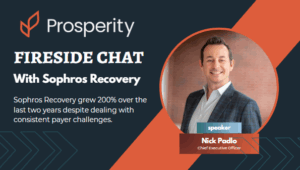
The best behavioral health organizations aren’t just built on business plans – they’re built on lived experience. This is the story of how personal struggle became purposeful mission.
Estimated reading time: 7 minutes
Nick Padlo’s path to founding Sophros Recovery wasn’t linear. It wound through West Point, the Army, Stanford Business School, a pet cremation business in Texas, and ultimately, two stays in treatment in 2018.
“I started to struggle with addiction and mental health, primarily alcohol and cocaine, but also depression and anxiety,” Nick shared during a recent webinar conversation. After treatment, he spent time in Cambodia studying mindfulness, then returned to Jacksonville with a clear purpose: “helping other people who were struggling with the same kind of stuff I was.”
That clarity of purpose – born from personal experience – would become the foundation not just of Sophros’s clinical approach, but of its entire business model.
Starting With Why
In business development, Nick doesn’t lead with credentials or program features. He leads with story.
“I’m Nick and I’m an addict in recovery trying to help other addicts. We do that through our PHP IOP.”
It’s a simple shift, but it changes everything. In an industry where everyone claims to offer “quality care” and “client-centered treatment,” authenticity cuts through the noise.
“Your founder is one of your salespeople at this level,” Nick explained. “It means a lot when someone gets a visit from the CEO, even though they don’t know that you have five people on your team.”
But it’s not just about the title. It’s about the story. And Nick’s story is one that resonates because it’s real.
This authenticity principle extends beyond the founder. Nick emphasizes that every team member should lead with their “why” – whether they’re in recovery themselves, have a family member who struggled, or had another defining experience that brings them to this work.
“Not everyone has that story,” he acknowledges, “but we should be leading with our why. There’s a Simon Sinek video that’s great on ‘Start With Why.’ I think it’s so important.”
Building Something Different
When Sophros opened its doors in Jacksonville, it started small: three employees, no housing, just a standalone PHP/IOP program. But from the beginning, the approach was different.
“We were authentic about our message and who we are. We were very clear about our mission and values, and we talked about those first in everything that we do,” Nick reflected.
This wasn’t just marketing speak. It was operational reality. The focus on quality care and the right people executing a solid plan created something tangible – a program that actually delivered on its promises.
The proof came gradually: successful clients, positive outcomes, five-star ratings, word-of-mouth referrals. Within a year and a half, the team had grown from 3 to 30 employees in Jacksonville alone.
But here’s where Nick’s story diverges from many in the industry: he didn’t immediately try to scale aggressively.
The Discipline of Recovery, Applied to Business
Nick is candid about his natural tendencies: “I’m a true alcoholic. I am not naturally disciplined. I’m naturally impulsive. I am naturally risk-seeking. I’m naturally self-destructive. Those are my default mode.”
In active addiction, those traits were destructive. In recovery, he’s learned to channel them differently – through structure, measurement, and intentional discipline.
“I thrived in the Army because it forced that upon me. When I got out, I didn’t have it again. For me, I have to consciously add discipline.”
That conscious discipline shows up everywhere in his life now. He can tell you his average daily step count on his Apple Watch (between 6,075 and 6,100). He tracks his sleep, his workouts, his key business metrics.
“I measure these things because if I don’t measure them, I can’t manage them. That discipline I find when I exercise in my life, I try to extend that to the business.”
This shows up in Sophros’s growth strategy in three key ways:
Financial Discipline: Rather than raising institutional capital, Sophros grew through operational cash flow. “When the cash flow of the business surpassed what I budgeted as the negative cash flow of the new business,” that’s when Nick knew expansion made sense.
Did this slow them down? Yes. Did it force them to get Jacksonville truly stable before expanding to Tampa? Absolutely. And that was the point.
“Not having outside capital frees you up from external pressure to grow and deliver IRR or rapid returns,” as Greg Keilin noted in the conversation. “But you also need to be a governor of your own ambition and expectations.”
Strategic Discipline: Nick follows what he calls the “one-step adjacency” rule (from Michael Zook’s book “Beyond the Core”): only take one step away from what you know.
Tampa was the same service model in a new geography – one unknown. Jacksonville outpatient was a new service line in a familiar market – one unknown. What they didn’t do: open a detox in Miami. That would have been two unknowns simultaneously.
“I can’t have two unknowns. I have to have one solvable unknown and let me go and solve that,” Nick explained.
Operational Discipline: The rhythm became: grow, stabilize, grow, stabilize. No expansion until current operations were running smoothly.
“The discipline has allowed me to maintain quality care. It acts as a natural governor to overly expanding. I can’t expand until everything’s running well.”
When the Map Differs from the Territory
Not everything went according to plan. Tampa took longer to gain traction than expected. The first business development hire didn’t work out. Jacksonville had some dips.
“Some of those bad risks did come to fruition,” Nick admitted. “So I had built, clearly, enough cushion for some of the things to go wrong. I did not have enough cushion for a catastrophic case. However, I didn’t leave myself just enough cushion for it to go perfect.”
This is the reality of entrepreneurship: planning for the likely, preparing for the challenging, while accepting you can’t predict everything.
The Tampa struggle taught Nick about the importance of local leadership. “I spent time there, but it’s not my home. I’m not able to go and sell every day in the community. My time is lessened.”
After moving on from that first BD hire, “we’ve since seen ourselves gain momentum. But don’t underestimate the power of that leadership team being local.”
The Long Game
Today, Sophros operates PHP/IOP programs in Jacksonville and Tampa, virtual IOP services in English and Spanish, and has recently acquired an outpatient practice in Jacksonville. They maintain five-star ratings at both physical locations.
But Nick isn’t chasing unicorn status or planning a rapid national rollout. He’s building something sustainable.
“We’re not private equity backed,” he noted. “I raised a little bit of money from friends and family at the beginning, and myself. We don’t have the deep pockets. What that’s forced for me is an extra level of discipline.”
That discipline isn’t a limitation – it’s a feature. It ensures that every expansion is earned, every location is stable, and quality care remains at the center.
“As soon as we start to not provide quality care, then we become a transactional treatment facility, just like everybody else. And I’ve got nothing to sell other than pretty marketing materials,” Nick said.
The Mission as the Method
Perhaps the most striking aspect of Nick’s approach is how completely his personal recovery journey has shaped his business philosophy.
The authenticity that works in BD? That came from learning to be honest about his own story.
The emphasis on one-step growth? That mirrors the “one day at a time” principle of recovery.
The focus on measurement and discipline? That’s directly borrowed from working a program and tracking progress.
The insistence on quality care above all else? That comes from someone who knows personally what it means to be on the other side of that care.
“At the end of the day, if we start a relationship, how do we continue to harness that?” Nick asked. “And as we grow, making sure that we maintain our culture and our outcomes. Because as soon as that starts to dip, we become just like everybody else.”
This isn’t just a business. It’s a mission informed by lived experience, executed with intentional discipline, and scaled with careful attention to what actually matters.
When asked about his final takeaways from the conversation, Nick returned to the foundation: “We were authentic about our message and who we are. We were very clear about our mission and values, and we talked about those first in everything that we do. We provided quality care. We measured our results. And we made adjustments.”
In other words: stay true to your why, do the work well, and grow thoughtfully.
It’s not the fastest path. But for Nick Padlo and Sophros Recovery, it’s the right one.
Want to hear the full conversation?
👉 Watch the complete webinar with Nick Padlo and Greg Keilin here