Quick Summary
Effective IOP billing enables SUD and mental health providers to deliver top-tier outpatient care while generating strong per diem revenue through appropriate HCPCS codes. With proper authorization, documentation, and coding of UB-04 claims, providers gain financial stability and expand access to essential BH services.
Ready to Secure More Reimbursements?
IOP billing is a major source of frustration and lost revenue for SUD and mental health providers
High denial rates, complex payer requirements, and documentation pitfalls drain cash flow, generate mountains of rework, and put the sustainability of these vital programs at risk.
Every delayed or denied claim doesn’t just hurt your organization.
It strains operational budgets, forces difficult staffing decisions, and leaves vulnerable patients without the consistent support they need to recover.
Well, it shouldn’t be that way. As a BH provider, you can secure the reimbursements you deserve. Without compromising critical service delivery,
This guide discusses strategies to master IOP billing from applying the right HCPCS codes to completing UB-04 claims and building bulletproof clinical documentation that withstands audits.
Why Listen to Us?

Our revenue cycle team at Prosperity BH has processed thousands of IOP claims across commercial, Medicaid, and Medicare payer lines.
We’ve tracked denial patterns, won appeals, and helped programs restructure their billing workflows to recapture lost revenue.
Our behavioral health RCM solutions are built for providers like you. We understand the nuance that general medical billers miss.
What Is IOP?
IOP is a structured level of care for individuals navigating SUDs, mental health challenges, or both.
It allows patients to live at home and maintain their daily responsibilities while attending group therapy, counseling, and skills sessions for 3–4 hours per day, 3–5 days per week.
The services are reimbursed on a per diem basis. To qualify for full-day reimbursement, most payers require at least 3 hours of programming per day, along with consistent weekly hour thresholds and accurate documentation.
HCPCS Codes for IOP Billing
IOP services rely on HCPCS coding for billing. Add the correct per diem HCPCS codes to eliminate billing delays and denials and get paid faster for the care you deliver. Here are the main HCPCS codes:
1. H0015
H0015 is used to bill SUD IOP services. It provides a bundled approach to treatment for alcohol, drug, and other SUDs. This code emphasizes evidence-based interventions delivered under medical supervision. As a per diem code, one unit of H0015 is billable once the patient receives at least 3 hours of appropriate services on that day, as part of a program that operates at least 3 days per week.
2. S9480
S9480 is the HCPCS Level II code for billing mental health IOP. It covers common disorders such as depression, anxiety, bipolar disorder, and schizophrenia. To qualify for S9480 billing, programs must deliver at least 3 hours of therapeutic services per day, scheduled 3–5 days per week. Similar to H0015, sessions here combine group therapy, individual counselling, and much more.
UB-04 Claim Form and Revenue Codes for IOP
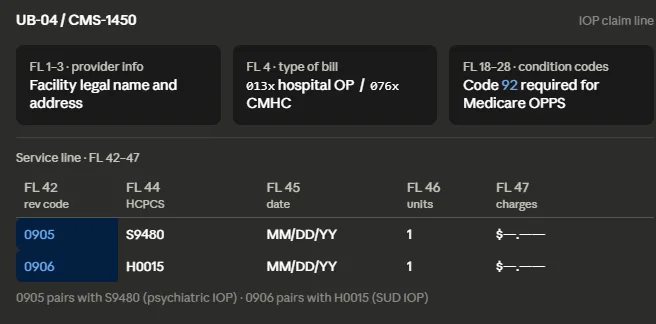
The IOP per diem program fee covers a range of coordinated clinical services. Bundling such services aligns reimbursement with the nature of IOP care.
Next, we’ll discuss claim forms and revenue codes in detail.
Submitting IOP Claims on UB-04
IOP claims are submitted on the UB-04 paper form or its electronic counterpart, the 837I. This claim format gives you the flexibility to report services using the precise revenue and procedure codes required for psychiatric and SUD programs.
To process your claims smoothly, fill out the correct fields on the UB-04. Here are the most important Form Locators for IOP billing:
- FL 1–3: Enter provider information, such as the facility’s legal name and address.
- FL 4: Use the correct 4-digit code matching your facility type and payer rules, e.g., 013x for hospital outpatient or 076x for CMHCs.
- FL 18–28: For Medicare IOP claims, include Condition Code 92 for proper processing under the OPPS.
- FL 42: Report revenue code 0905 for psychiatric IOP services or 0906 for SUD IOP services.
- FL 44: Pair the revenue code S9480 for mental health IOP or H0015 for SUD IOP.
- FL 45: List the date of service for each line item.
Revenue Codes on the UB-04 Form
For IOPs, these two reliable codes should be your entries in FL 42:
- 0905 for IOP, Psychiatric
- 0906 for IOP, Chemical Dependency
Most major payers recognize and accept these codes. Follow these steps for each service line on the UB-04:
- FL 42: Enter 0905 or 0906
- FL 44: Report the matching HCPCS code that describes the specific service provided.
- FL 45: Indicate the service date for that line item.
- FL 46: Bill 1 unit.
- FL 47: Enter the total charges for the service line.
Consistency is key here. When Fields 42 through 47 are aligned, your claims are more likely to sail through adjudication with minimal scrutiny.
Prior Authorization and Concurrent Review
Prior authorization and concurrent review are critical utilization management requirements for IOP services. It ensures that IOP treatment is medically necessary and appropriate for the patient’s current level of care. Let’s discuss them in depth.
How to Secure Prior Authorization
Several payers require prior authorization either before day 1 or immediately after admission, accompanied by clinical documentation demonstrating that the patient meets medical necessity criteria.
Follow this process to position your program for success:
- Verify eligibility and benefits to confirm IOP coverage, session limits, and in-network status.
- Build a compelling documentation package, including a comprehensive biopsychosocial assessment, DSM-5/ICD-10 diagnosis, and a treatment plan with measurable goals.
- Justify the IOP level of care by addressing the patient’s needs through ASAM’s six dimensions.
Submit packages within 7–14 days. Once approved, track authorization numbers, approval dates, and expiration timelines so you can request extensions before they lapse.
This step prevents interrupting care and minimizes financial risk for your program.
Concurrent Reviews
After the initial authorization, some payers still require regular clinical check-ins to confirm that ongoing care remains medically necessary. Falling behind here triggers denials.
Here’s how to turn concurrent reviews into a smooth process that will increase your reimbursement rates:
- Build a calendar-based system focused on each patient’s authorization end date so nothing slips through the cracks.
- Send updated clinical documentation 3–5 days before the deadline. Include progress notes aligned with treatment goals, attendance records, and other relevant information.
- Highlight ongoing symptoms, relapse risk, or barriers to safe step-down.
- Maintain discharge planning records in every review to demonstrate appropriate care.
Do proactive concurrent reviews, and you’ll get better outcomes across the board.
Important Modifiers and Place of Service Codes
Modifiers give payers the complete context they need to process claims and get programs paid faster. Here are the main modifiers every SUD IOP program should know:
- HF Modifier: It signals that services were delivered as part of a formal addiction treatment program. Ex: H0015 HF.
- Provider Level Modifiers: They provide evidence that qualified licensed staff delivered the care. Ex: HP for doctoral-level professionals, such as psychologists. Maintain an up-to-date behavioral health credentialing checklist to meet all payer requirements for these modifiers.
- Telehealth Modifiers: Add 95 for telemedicine delivered via real-time interactive audio and video, and 93 for audio-only sessions.
- Place of Service Codes: Include POS 10 for services delivered in the patient’s home and POS 02 for telehealth services originating from a facility or clinic.
IOP Reimbursement Rates by Payer
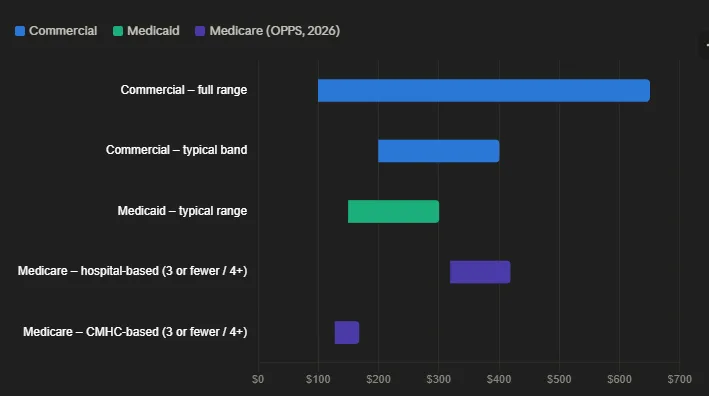
Reimbursement for IOP varies by payer, contract terms, geographic region, level of care, and negotiated rates. Understanding these benchmarks is essential for providers to optimize BH revenue. The following ranges represent industry benchmarks across major payer types:
Commercial Insurance Rates
For in-network providers, commercial per diem reimbursement rates for IOP generally range from $100 to $650 per day. Most programs cluster comfortably in the $200–$400 range. ~$100–$250 rates at the lower end are common in more competitive or lower-cost markets, while higher reimbursements around $350–$650+ are achieved through payer contracts, hospital-based programs, or facilities in high-cost regions.
Medicaid IOP Reimbursement
Many state Medicaid per diems for IOP fall roughly in the $150–$300 range per day, though some are lower, under $100 in hourly models or higher, depending on adjustments, provider type, or add-ons. For instance, some states pay approximately $250 using code S9480. Others offer around $270 with H0015/S9480. There is no single national rate or uniform range. These rates are approximate and may change with time.
Medicare OPPS Rates for IOP
Medicare reimburses IOP services on a per-diem basis under the OPPS, primarily for CMHCs. Coverage for these services began on January 1, 2024, expanding access to BH treatment. Providers bill using Condition Code 92 on institutional claims and receive per-diem payments that are tiered according to the number of services delivered each day.
The finalized OPPS rates, effective January 1, 2026, are as follows:
- Hospital-based IOPs: $319.38 for 3 or fewer services per day and $418.45 for 4 or more services per day.
- CMHC-based IOPs: $127.74 for 3 or fewer services per day and $167.38 for 4 or more services per day.
This tiered per diem structure provides predictable reimbursement, thereby supporting sustainable outpatient care.
Common Denial Triggers for IOP Claims
Denial rates for IOP claims don’t just delay cash flow. They create administrative headaches and disrupt continuity of patient care. Below is a deeper dive into the frequent denial triggers we see across commercial, Medicaid, and Medicare Advantage plans
1. Authorization-Related Denials
IOP services require strict PA and ongoing reauthorizations due to their intensive level-of-care requirements. Missing, expired, or improperly managed authorizations lead to hard denials.
Here are the most frequent pitfalls that trip up billing teams:
- No prior authorization obtained. Submitting claims without approval results in automatic denials.
- Gaps in reauthorization. A missed renewal window results in permanent revenue loss for those dates of service.
- Authorization for the wrong level of care. Claims get denied when billed services exceed approved units, dates, or intensity.
- Step-up/step-down without proper authorization: Transitioning from outpatient to IOP, or vice versa, without a new pre-authorized clinical review results in denials.
- Inadequate documentation supporting authorization. Claims can be denied post-service if supporting docs don’t align with payer criteria.
That said, strong processes for PA initiation, timely renewals, and documentation are mandatory to protect your revenue. Specialized behavioral health denial management services can help you streamline these processes for your program to reduce your denial rates.
2. Medical Necessity and Documentation Failures
Too often, clinical notes fail to demonstrate why the patient needs IOP and how each intervention directly advances their individualized treatment goals. Common deficiencies include outdated or missing treatment plans, insufficient documentation of the required minimum hours, and a lack of explicit alignment with ASAM Level 2.1 criteria for SUDs. Without these elements, it becomes nearly impossible to prove that a less intensive level of care would be inadequate to address the patient’s acute symptoms, risk factors, and functional impairments, leading to denials.
3. Coding Errors
Submitting codes that don’t align with the payer’s specific requirements results in denial codes such as CO-97, CO-4, or CO-16. Some common pitfalls include using standalone CPT codes, such as 90853 or 90834/90837, instead of the appropriate IOP-specific codes. Also, claims are denied when billing teams enter the wrong revenue codes on UB-04 forms. For instance, 0905 for psychiatric IOP and 0906 for SUD IOP.
Documentation That Defends the Claim
Strong documentation transforms clinical excellence into a bulletproof record that safeguards your organization’s revenue. Let’s discuss how to build documentation that aligns with payer requirements:
- Admission documentation: Support the assessment and physician certification with details on the patient’s history, symptoms, and alignment with the ASAM criteria or equivalent criteria.
- Individualized treatment plan: Create a patient-specific plan with measurable goals, defined services, and clear treatment timelines.
- Progress notes: Document exact service times, interventions linked to treatment plan goals, the patient’s active participation, and their progress.
- Attendance and service tracking. Maintain accurate attendance logs and service-tracking records to validate that delivered hours and units match billing requirements.
- Discharge planning: Deliver a discharge summary that ties everything together by showcasing goals achieved and confirming a clinically appropriate transition to a lower level of care.
Draft records that capture the most important client data, and you’ll withstand regular audits and reviews. Healthcare automation further strengthens this process by improving documentation accuracy and real-time compliance tracking.
Maximize Your IOP Reimbursements with Confidence
The difference between a smooth revenue cycle and constant denials add up to lost revenue each month.
At Prosperity BH, our expert billing services and RCM solutions help reduce denials, speed up payments, and maximize revenue for BH providers.
We assist BH providers meet minimum service hours, document medical necessity, or handle payer-specific rules to stay on top of the details.
Schedule your free revenue cycle assessment today. We’ll review your current IOP workflows, denial patterns, and documentation practices, then deliver a customized roadmap to strengthen your billing and boost your financial performance.