

Quick Summary
Several behavioral health providers suffer repeated payment delays, cash flow bottlenecks, and revenue loss, even with numerous patients. Behavioral health credentialing smoothens workflows between insurers and providers, reducing missed payments and denials to maximize profit and financial efficiency.
The Process That’s Secretly Costing You
Before you can bill insurance, get reimbursed, or scale your behavioral health practice, proper credentialing must take place. This is the step that determines whether insurers recognize your organization, approve your claims, and actually pay you. It’s also where many providers unknowingly lose revenue.
A single name mismatch between your NPI record and CAQH profile can stall an application for months. An expired attestation can trigger claim denials across every payer you’re enrolled with. These aren’t edge cases. They’re common, and they compound quickly.
Below, we’ll provide an expert checklist for the credentialing process that helps you maintain proper oversight, avoid these pitfalls, and get approved faster.
Why Listen to Us

At Prosperity, we’re experienced at providing revenue cycle management tailored to behavioral health providers. We understand the credentialing and compliance issues that create administrative bottlenecks and how to fix them.
Our numbers prove our expertise, with over 90% first-pass payment rate, 98% collectible revenue captured, and under 45 days-to-pay for commercial claims.
What is Behavioral Health Credentialing?
Behavioral health credentialing is the process insurance companies use to verify that a provider is eligible to render behavioral health services and receive reimbursement. It confirms your practice’s licensure, compliance, and documentation to the patient’s insurer, which then determines whether to approve or deny your claims.
For every branch of behavioral healthcare, whether therapy, psychiatry, addiction treatment, or Partial Hospitalization (PHP), your organization must show licensure and compliance with state regulations to join insurance panels.
Successful credentialing demands strict documentation, and many providers miss this, causing delays, denied claims, and lost revenue.
Credentialing vs. Contracting
Credentialing and contracting are often used interchangeably, but they’re two distinct stages of joining a payer network.
Credentialing is the verification step, where the insurer confirms your licenses, qualifications, and compliance. Contracting comes after, where you review and sign a participation agreement that sets your reimbursement rates, payment terms, and obligations. Understanding this distinction matters because being credentialed doesn’t mean you can bill yet.
You need a signed contract and a confirmed effective date before submitting claims.
Why Does Proper Credentialing Matter?
When mismanaged, credentialing becomes one of the most preventable sources of revenue loss in behavioral health. From stalled payer contracting to months of denied claims, the downstream effects are significant. Here’s why it’s important to get behavioral health credentialing right:
1. It Determines Approvals
Improper, careless, or incomplete credentialing leads to rejected applications, retroactive claim denials, and write-offs. Even small documentation errors, like a provider name that doesn’t exactly match your NPI registration, can result in months of appeals. A clean, detailed process prevents this problem, improving first-pass payment rates and reducing unnecessary revenue leaks.
2. It Affects Cash Flow
A Medallion report showed that 18% of hospitals and provider groups experience credentialing delays of 60+ days. This is a problem because you can’t bill insurance until credentialing and enrollment are approved.
When these are delayed, revenue equally slows down. For a practice expecting $50,000/month in reimbursements, a 60-day credentialing delay means $100,000 in deferred revenue before you’ve even submitted your first claim. With financial strains like that, responsibilities like payroll, rent, or scaling become significantly harder.
3. It Protects Compliance
Payers verify licensure and compliance to prevent regulatory penalties or legal risk. Wrong information or missed documentation cycles expose your practice to claim denials, audits, fines, or network removal. By conducting a thorough credentialing process, you protect your organization’s professional reputation and payer relationships.
The Behavioral Health Credentialing Checklist
Following a structured process is key to proper behavioral health credentialing. A laid-out, step-by-step plan for accurate submissions makes the entire procedure more organized and less overwhelming. Here’s an easy checklist to guide you below:
1. Payer Strategy
Before the actual credentialing process, you must have identified which payers align with your business model, patient demographic, and geographical location. Some questions to ask include:
- Which commercial insurers dominate your geographical area?
- Which insurers are common with your patients and referral partners?
- Are these payer panels open or closed to new providers?
- What are the reimbursement rates for our levels of care (OP, IOP, PHP, RTF, detox)?
- Do we meet Medicare and Medicaid participation requirements?
- Does this payer cover virtual visits, if applicable?
Some payers shouldn’t be pursued, as they may not be suited to your specific goals, ideal rates, or patients. Strategizing first helps you pinpoint the most beneficial insurers, improves your efficiency, and reduces errors in the long run.
2. Verified Documents
Before initiating applications, check that all your documents are accurate, current, and complete. Required credentials usually vary depending on the payer, state, and your specific area of behavioral health.
However, some documents are standard for most commercial insurers and government payers. They include:
- National Provider Identifier (Type 1 or Type 2)
- DEA registration (if prescribing)
- Malpractice insurance certificate
- Board certifications
- Education and training verification
- Government-issued ID
- OIG/SAM exclusion checks
Beyond these, specific requirements vary by provider type. The table below outlines the key credentialing documents and qualifications expected for common behavioral health roles:
| Provider Type | Key Credentialing Requirements |
| Psychiatrists (MD/DO) | Board certification or eligibility, DEA registration, admitting privileges or escalation plan |
| Psychologists | State license, doctoral degree verification, malpractice coverage |
| LCSWs | State clinical license, supervised experience documentation, ASWB exam |
| LPCs/LMHCs | State license, master’s degree verification, supervised hours |
| Psychiatric NPs/CNSs | State license, national certification, DEA registration (if prescribing) |
| Addiction Counselors | State certification/license, documented training hours, supervision records |
Organizations offering higher-acuity services may need additional documents, such as telehealth compliance attestations, disclosure statements, proof of accreditation, or tax ID and W-9 forms.
Regardless of the documents requested, you must ensure consistent information across every submission. Provider names, addresses, and taxonomy codes should match exactly across your NPI, CAQH, and each payer application. Even minor inconsistencies (like “St.” vs “Street” or a middle initial on one form but not another) can trigger additional review cycles that add weeks or months to your timeline.
3. Completed and Attested CAQH Profile
The Council for Affordable Quality Healthcare (CAQH) is a centralized online database that collects and verifies provider information for commercial insurance companies. Insurers who need to confirm your eligibility for reimbursement pull your practice’s details from this database.
While centralizing information allows for more seamlessness, the downside is that an incomplete or inaccurate profile either slows down all your applications or renders them invalid.
Use these pointers to confirm that your profile is complete:
- Is every section filled out, including your educational background, licenses, certifications, work history, and professional references?
- Are all supporting documents uploaded, up-to-date, and legible?
- Is your work history detailed, with gaps over 30 days explained?
- Has the profile been attested?
- Is the attestation current (within 90-120 days)?
4. Payer Applications
Once your documentation and CAQH profile are ready, you can proceed with submitting and applying to your insurer networks. These questions help you verify that you’re ready to submit:
- Has all the required documentation been finalized?
- Have selected payers been authorized to access your CAQH profile?
- Have any payer-specific forms or portal submissions been completed?
- Have you fulfilled all supplementary documentation requests?
- Have you saved submission confirmations, such as confirmation number, receipt, and reference ID?
- Do you have a tracking sheet documenting payer names, submission dates, and expected timelines?
5. Confirm Follow Up
Contrary to what many providers believe, submitting your application isn’t the finish line; you must follow it up judiciously. Within regular intervals, it’s essential to contact your payers to confirm receipt and get updates.
Failing to do this may keep you in the dark if issues that could affect your application come up. Typically, though, payers contact your practice in the event of extra requests or clarifications, and you should respond quickly to avoid timeline setbacks.
Look out for these when conducting follow-ups:
- Have payers been contacted at regular intervals to confirm receipt and status updates?
- Have all additional requests or clarification notices been addressed promptly?
- Has the participation agreement been reviewed in full?
- Are reimbursement rates verified?
- Are termination clauses, deadlines, and payment terms reviewed?
- Have billing details and payer codes been entered and confirmed?
- Are you billing payers before your official effective date?
Common Credentialing Mistakes Providers Make
Losing revenue from credentialing is common when the provider doesn’t know what errors they’re making. Below are some common credentialing mistakes and how to fix them.
1. Letting Re-Attestation Expire
Re-attestation is simply confirming that the details on your CAQH profile, such as licenses, malpractice coverage, or work history, are still correct. Most commercial insurers require re-attestation every 120 days, and without it, re-credentialing is likely to be delayed or claims outrightly rejected. Set calendar reminders at 90 days to give yourself a buffer before the deadline hits.
2. Signing Unfavorable Fee Schedules
When a payer approves your credentialing, they send you a participation agreement that includes your rates or fee schedules. What many providers don’t realize is that those numbers aren’t always fixed.
To prevent getting paid below market rates, ask if fees are negotiable, compare your offer against regional averages, and evaluate profitability before signing. If a payer’s rates don’t cover your cost of care for a given level of service, it may not be worth joining that panel.
3. Billing before Confirming Activation
Getting approved starts the clock, but it doesn’t necessarily equal effective billing status. Payers can still deny claims if you submit them earlier than your given effective date.
Some payers make your effective date the date of approval, but this must never be assumed. Instead, confirm in writing to ensure you’re officially in-network before billing for reimbursements.
4. Incomplete Documentation
Between rushing through applications and staff who don’t fully understand behavioral health credentialing nuances, providers end up submitting inaccurate or incomplete applications. As a result, additional reviews push timelines, sometimes over 120 days, for minor discrepancies such as name variations or wrong coding.
Rather than loosely working harder on paperwork, build a structured credentialing process that includes:
- Clear documentation standards
- Centralized tracking
- Calendar-based re-attestation
- Proactive follow-up schedules
- Contract review before signing
For some organizations, building this process internally is ideal; however, most practices, especially growing or multi-site operations, benefit more from outsourcing.
Should You Outsource Behavioral Health Credentialing?
A lot of behavioral health practices juggle patient care, hiring, compliance, and management simultaneously. When credentialing is handled in-house without dedicated staff or systems, documentation falls through the cracks. Certifications lapse, re-attestation deadlines pass, and follow-ups lose priority, all of which affect credentialing speed and pass rates.
If you’re nodding yes to any of these, then your practice needs external help:
- Your staff lacks behavioral health credentialing expertise.
- You don’t have a clear tracker for applications, deadlines, and follow-ups.
- Backlogs for CAQH re-attestation or document updates.
- Payer applications have been in review for 90+ days with no proactive follow-up.
- You’ve signed contracts without fully analyzing reimbursement rates.
- Credentialing feels reactive, meaning you only focus on it when cash flow gets tight.
While outsourcing can fix these problems, choosing the right partner determines how effective the solution will be. Prosperity combines deep behavioral health expertise with structured workflows that reduce errors and improve time-to-reimbursement.
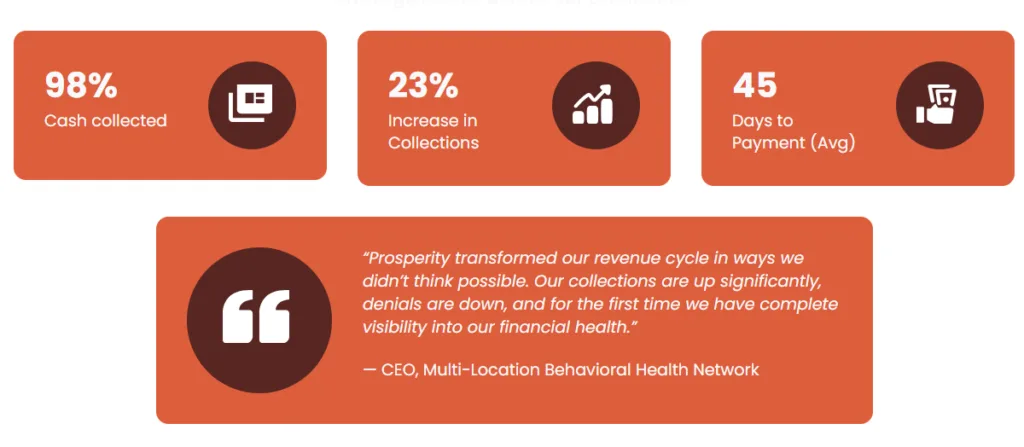
Our team proactively manages CAQH profiles, payer submissions, contract review, and confirmations, so you’re not chasing updates while running your practice. Our structured approach has yielded 90%+ first-pass payment rates, days to pay under 45 for commercial plans, and 98% of collectible revenue captured.
In place of spreadsheets, guesswork, or overwhelmed staff, you get data-driven analytics services and a partner focused on strengthening your bottom line from day one.
Get Credentialing for Long-Term Performance
Behavioral health credentialing can either become a huge bottleneck for your revenue or fast-track your financial performance. Getting it right from the start reduces your risk of losses or denied claims, stabilizes your practice, improves profitability, and positions your organization for long-term growth.Stop struggling with credentialing. Contact Prosperity to handle your documentation while you streamline your focus on patient care.