

Quick Summary
Mental health practices lose significant revenue to claim denials, payer underpayments, missed charges, and patient non-collection. Recovery requires systematic denial management, contract compliance monitoring, charge capture audits, and patient AR follow-up.
You’re Probably Leaving Money on the Table
Most mental health providers don’t know how much revenue they’re losing. They see the deposits hit their account and assume they’re getting paid correctly.
However, healthcare practices commonly lose 3-5% of revenue to charge capture failures alone. Add payer underpayments (another 1-3% of net revenue), unworked denials, and uncollected patient balances, and total leakage can approach 10% of what you’re owed.
Mental health billing faces additional headwinds. Behavioral health claims are denied at rates 85% higher than comparable medical services, despite federal parity laws requiring equal coverage. Insurers scrutinize documentation more aggressively, apply arbitrary session limits, and frequently underpay against contracted rates.
The good news? Much of this revenue is recoverable if you know where to look and have the systems to pursue it.
Why Listen to Us

Prosperity provides revenue cycle management exclusively for behavioral health providers. Our clients consistently achieve 98% cash collection rates, first-pass payment rates above 90%, and days to payment under 45 for commercial claims. We recover revenue that in-house teams miss because we know exactly where behavioral health billing breaks down.
What Is Revenue Recovery?
Revenue recovery is the process of identifying and collecting money you’ve already earned but haven’t received. It differs from revenue cycle management (which focuses on getting claims paid correctly the first time) in that it targets money that’s already slipped through the cracks.
In mental health billing, revenue recovery falls into four categories:
- Denied claims. Claims insurers rejected but can be appealed and overturned.
- Underpayments. Claims the insurer paid at less than your contracted rate.
- Missed charges. Billable services you provided but never submitted a claim for.
- Patient AR. Balances patients owe but haven’t paid.
Each category has different causes and requires different recovery tactics. The sections below cover how to identify and recover revenue in each.
1. Denied Claims: Revenue You Can Appeal
Up to 30% of mental health claims are initially denied. The majority are recoverable, but most practices never rework them.
Mental health claims face higher scrutiny than medical claims. Insurers demand detailed documentation of medical necessity, apply arbitrary session limits, and reject claims for technicalities that wouldn’t flag a primary care visit. The Mental Health Parity Act requires equal treatment, but enforcement is weak and violations are common.
How to Identify the Opportunity
Start by quantifying the problem. Pull a report of all denied claims from the past 12 months and categorize them by denial reason: eligibility issues, missing authorization, documentation insufficiency, coding errors, or payer policy disputes.
This categorization reveals patterns. If 40% of your denials stem from missing prior auth, you have a front-end process problem. If most are documentation-related, your clinical notes aren’t supporting the claims. If you’re seeing a spike in denials from a specific payer, they may have changed policies without notifying you.
Calculate the dollar value of denied claims by category. This tells you where to focus recovery efforts first and helps build the business case for process improvements.
How to Recover
Effective denial recovery requires a structured workflow. Here’s a process that works:
- Triage denials within 48 hours of receipt. Sort into categories: quick fixes (missing info you can supply), appeals requiring clinical documentation, and write-offs that aren’t worth pursuing. Speed matters because payers have appeal deadlines, often 60-90 days from denial.
- Assign clear ownership by denial type. Eligibility denials go to your front desk supervisor. Clinical documentation appeals go to a billing specialist who works directly with clinicians. Coding disputes go to whoever handles your coding. When everyone owns denials, no one owns them.
- Build appeal templates for common scenarios. Mental health appeals often require clinical statements demonstrating medical necessity. Create templates that clinicians can complete quickly, with prompts for the specific language payers want to see. A 15-minute template is more likely to get completed than a request for a “letter supporting the claim.”
- Track outcomes and refine. Monitor your overturn rate by denial type and payer. Well-prepared mental health appeals can achieve success rates above 50%. If yours is significantly lower, review your appeal documentation. If a specific payer rarely overturns appeals, stop wasting time on them and focus on prevention instead.
- Feed patterns back to the front end. Every denial you successfully appeal is a denial that shouldn’t have happened. Monthly denial reviews should include your admissions and clinical teams so they understand what’s causing problems downstream.
Underpayments: Revenue Disguised as Full Payments
Underpayments are insidious because they look a lot like full payments. The claim doesn’t deny. Money hits your account. Your team posts it and moves on. But the amount is less than your contract specifies.
Industry estimates suggest 1-3% of net revenue is lost to payer underpayments annually. Most practices never notice because they’re not comparing payments against contracted rates.
Common causes include:
- Payer applies wrong fee schedule or outdated rates
- Incorrect modifier interpretation reduces reimbursement
- Bundling or downcoding without justification
- Coordination of benefits errors
- Simple calculation mistakes on the payer’s end
How to Identify the Opportunity
Catching underpayments requires comparing what you received against what your contract says you should receive. Most practices don’t do this because it’s tedious, but the payoff can be substantial.
Here’s how to set up underpayment detection:
- Load your contracted fee schedules into your practice management system. Every payer contract specifies reimbursement rates by CPT code. If these aren’t in your system, you’re flying blind.
- Run payment variance reports monthly. These reports compare actual payments against expected payments and flag discrepancies. Set a threshold that makes sense for your volume. Investigating every $5 variance isn’t worth it, but $50+ variances on common codes add up fast.
- Segment by payer and CPT code. Underpayments often cluster. A payer might be applying the wrong rate to a specific service, or systematically misinterpreting a modifier. Looking at aggregate data by payer and code reveals these patterns.
- Check for fee schedule issues. If any payer is paying 100% of your billed charges, your fees are set too low.
How to Recover
Payers have processes for correcting payment errors, though they won’t volunteer the information. Document the contracted rate, attach the relevant contract language, and submit a formal request for the balance owed.
Also check your fee schedule. If any payer is paying 100% of your billed charges, your fees are too low. You’re billing below their allowable amount, which may mean you can safely raise your fees and collect more on every claim.
Missed Charges: Revenue You Never Billed
You can’t collect revenue for services you never submitted a claim for. Charge capture failures are common in behavioral health because of the variety of services provided and the complexity of documentation requirements.
Some services are more often missed than others:
- Group therapy sessions (documentation and billing often disconnected)
- Family therapy and collateral contacts
- Crisis intervention services
- Psychological testing administration and interpretation
- Care coordination and case management
- Telehealth sessions billed with wrong modifiers or place of service
How to Identify the Opportunity
Run a reconciliation between your clinical schedule and your claims submissions. Every patient encounter should have a corresponding claim. Gaps indicate workflow breakdowns, documentation failures, or staff uncertainty about what’s billable.
Also look for undercoding. Clinicians sometimes select lower-complexity codes out of caution or unfamiliarity with billing requirements. A 60-minute therapy session billed as 45 minutes is lost revenue on every single claim.
How to Recover
For recent missed charges, you can often still bill them:
- Check timely filing limits. Each payer has deadlines for claim submission, typically 90 days to one year from date of service. Know your limits by payer before you start pulling old encounters.
- Submit claims for recoverable services. Gather the documentation, code appropriately, and submit. For services close to the filing deadline, consider calling the payer to confirm the deadline before investing time in claim preparation.
- Fix the process for future prevention. Every missed charge you find should trigger a question: why did this happen? Train clinicians on billable services. Build charge capture verification into your daily workflow. Create a checklist for services that are frequently missed.
Patient AR: Revenue Patients Owe
Patient responsibility has grown significantly as high-deductible health plans have become more common. For many mental health practices, patient balances now represent a meaningful portion of total revenue.
The challenge is that patient collections require different tactics than payer collections. You’re billing individuals, not corporations. Payment ability varies. And aggressive collection can damage therapeutic relationships.
How to Identify the Opportunity
Run an aging report on patient balances. Segment by age: 0-30 days, 31-60, 61-90, 90+. The older the balance, the less likely you’ll collect. If most of your patient AR is over 90 days, your follow-up process is too slow.
How to Recover
Start by collecting what you can at time of service. Verify benefits before appointments so you can quote accurate patient responsibility. Collect copays and known coinsurance before the session, not after.
For outstanding balances, implement a systematic follow-up cadence:
- Statement
- Reminder
- Phone call
- Final notice
Offer payment plans for larger balances. Make it easy to pay with online options and clear statements.
Should You Outsource Revenue Recovery?
Revenue recovery is labor-intensive. It requires specialized knowledge of payer contracts, behavioral health coding, appeal processes, and compliance requirements. Most mental health practices don’t have the staff or expertise to pursue it systematically.
Signs you should consider outsourcing:
- Denied claims pile up because no one has time to work them
- You suspect underpayments but lack tools to verify
- Charge capture is inconsistent and you keep finding missed services
- Patient AR grows despite collection efforts
- You don’t know how much revenue you’re actually losing
The key is finding a partner with specific behavioral health expertise.
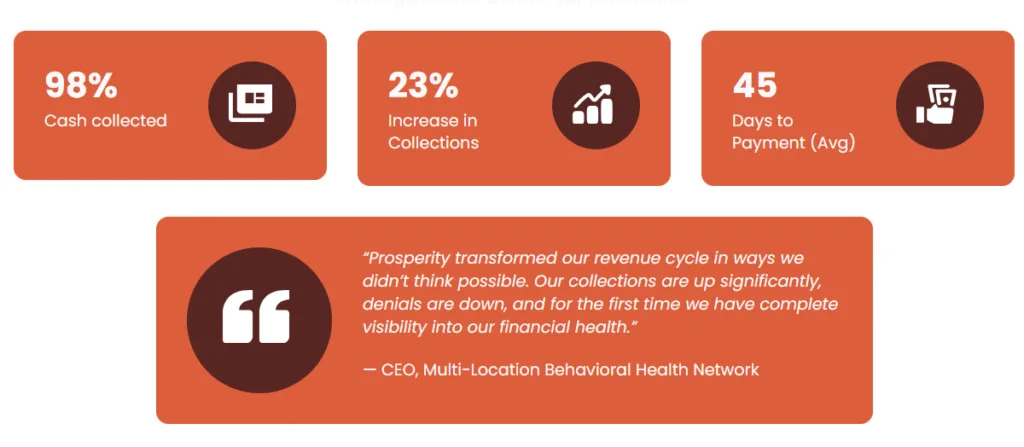
Prosperity handles revenue recovery as part of our full-service RCM for behavioral health providers. We systematically audit for underpayments, work denied claims with behavioral health-specific appeal strategies, identify charge capture gaps, and pursue patient balances. Our clients see first-pass payment rates above 90%, but we also recover significant revenue from claims that were previously written off or underpaid.
If you’re unsure how much you’re losing, start with an assessment. We can analyze your claims data, identify patterns, and quantify the opportunity.
Stop the Leakage
Revenue recovery matters, but preventing leakage matters more. Every dollar you chase down is a dollar that should have been collected correctly the first time.
Working through denied claims teaches you where your front-end process breaks. Auditing underpayments reveals contract compliance gaps. Investigating missed charges exposes workflow problems. Each recovery effort should feed back into prevention.If your practice is losing revenue across these categories and you don’t have the bandwidth to pursue it, contact Prosperity to discuss how we can help.