
On the IOP/PHP claims we audit, 11–18% of dollars billed are denied on first submission. About 65% of those denials are recoverable but most of the rest get written off because nobody had the staff or the workflows to chase them. That gap is what “denial management services” are sold to close.
The vendors do it very differently, and the wrong one will cost you six months of cash before you notice.
This isn’t a generic medical billing comparison. It’s specific to behavioral health’s IOP, PHP, outpatient, residential, and substance use disorder (SUD) treatment. The payer dynamics, authorization workflows, and documentation standards are different enough that a general RCM vendor’s denial playbook will leave money on the table.
What a denial management service actually does
At its core, a denial management service sits between your billing team and the revenue that payers owe you but haven’t paid. The daily workflow looks like this:
Triage. Every 835 remittance and EOB is reviewed and categorized by CARC/RARC code, which are the standardized reason codes telling you why a claim was denied or adjusted. A CO-50 means medical necessity. A CO-15 means missing or invalid authorization. A CO-29 means timely filing. Each one requires a different response.
Root-cause categorization. Denials get bucketed: eligibility, authorization, medical necessity, coding error, or timely filing. This categorization drives the appeal strategy and, more importantly, tells you where your upstream processes are breaking.
Appeal and follow-up. The service drafts appeal letters, submits supporting documentation, and follows up with the payer. For behavioral health, this often includes peer-to-peer review requests with your medical director.
Trend reporting. The best services report root-cause data back to your clinical and utilization review (UR) teams so they can fix the problems that created the denials in the first place.
That last point matters more than anything else. There’s a critical distinction between denial recovery (working the queue) and denial prevention (fixing upstream). Most vendors only do the first. If your partner isn’t feeding data back to your UR team, you’re paying someone to bail water while the hull stays cracked.
For a deeper look at the upstream issues, see our breakdown of the top reasons for behavioral health claim denials and how to prevent them.
The five ways behavioral health denials are different from medical
If you’ve been told a general RCM vendor can handle your denials, here’s what they’re probably not telling you.
1. Authorization-driven denials cascade. In behavioral health, a single bad utilization review call can trigger a chain reaction. A payer denies continued stay at the PHP level (CARC CO-197, precertification authorization absent), which means every subsequent day of service becomes an unauthorized claim. One missed concurrent review can generate dozens of denied line items. General medical billing rarely deals with this cascading pattern.
2. Medical necessity is subjective and payer-specific. There’s no universal standard for what constitutes medical necessity in behavioral health. One payer uses ASAM criteria. Another applies LOCUS. A third uses MCG guidelines and their interpretation of those guidelines may differ from the version your clinical team is trained on. For example, a CO-50 medical necessity denial on a PHP claim requires a clinically defensible appeal that speaks the specific payer’s language.
3. Volume of low-dollar claims changes the economics. Behavioral health generates high volumes of relatively low-dollar claims compared to traditional healthcare hospital-based specialties. If your denial recovery vendor takes 25–30% of recovered dollars, the math gets brutal on a $200 outpatient claim. Your vendor’s pricing model needs to account for this reality.
4. Out-of-network single-case agreements add complexity. Many behavioral health providers operate partially or fully out-of-network. Single-case agreements (SCAs) create a denial pattern, for example coordination of benefits issues, non-par provider adjustments, balance billing complications, that general medical billing teams rarely encounter.
5. Documentation barriers are unique. Group therapy notes, daily progress notes for residential programs, and telehealth place-of-service coding quirks create documentation challenges specific to behavioral health. Insufficient group notes or missing behavioral tracking data are among the most common drivers of UR denials we see.
How to evaluate a denial management vendor
Not all vendors are built the same. Here’s a 10-point checklist you can take into every evaluation:
- Do they work the full age bucket, not just incoming denials? Old AR is where money hides. If they only touch new denials and ignore claims sitting at 90 or 120-plus days, you’re leaving recoverable revenue untouched.
- Are appeal letters payer-templated and clinically defensible, or generic boilerplate? A CO-50 medical necessity appeal for a PHP claim to Aetna should look different from one to United Healthcare. Ask to see a sample.
- Do they report root cause weekly, or just dollars recovered? Recovered dollars are a lagging indicator. Root-cause data is the leading indicator that prevents future denials.
- How do they handle peer-to-peer requests? Do they escalate to your clinician with prep notes, or just pass the request back and hope someone picks it up?
- Do they have behavioral-health-specific staff? A billing rep who worked medical-surgical claims last month won’t know that a TRICARE claim needs to be consolidated into a single submission to avoid “out of sequence” denials, or that Highmark’s retro-auth window differs from United’s.
- What’s the pricing model? Flat fee per claim, percentage of recovered dollars, or a hybrid — and is there a volume floor? Make sure the model works for behavioral health’s high-volume, lower-dollar claim profile.
- What’s the tech stack? Do they bring their own dashboard for tracking denial status and trends, or are they piling into your EHR and creating more complexity?
- What’s the SLA for first-touch on a new denial? Target: less than 72 hours from receipt. Anything longer and timely filing risk compounds.
- Do they handle secondary submissions and third-party liability (TPL) coordination? Behavioral health patients frequently have Medicaid as a secondary payer. If your vendor doesn’t coordinate these, you’re missing recoverable dollars.
- Will they sign a BAA and pass an audit? This should be table stakes, but ask anyway.
The three categories of denial management services
Rather than ranking individual companies, which changes every year, here’s a framework for understanding your options.
Category 1: Full-service RCM partners
These vendors handle denials as part of a broader revenue cycle management (RCM) engagement that includes eligibility verification, utilization review, claims submission, AR follow-up, and payer contract negotiation.
Pros: Single point of accountability. The denial prevention feedback loop is real because the same team managing your UR is also seeing the denial data. Upstream fixes actually happen.
Cons: Requires a broader commitment. Often a minimum revenue threshold or contract term. More expensive than standalone denial work.
Typical cost model: 4–6% of collections (denials included in scope).
Who it’s for: Multi-site behavioral health providers or organizations billing more than $200K/month who need end-to-end RCM, not piecemeal fixes.
Examples: Prosperity Behavioral Health, Coronis Health, Hansei Solutions
Category 2: Standalone denial-only specialists
These vendors focus exclusively on denial recovery. Basically, they take your denied claims, work the appeals, and return recovered dollars.
Pros: Lower cost at small volumes. Fast onboarding because the scope is narrow. You keep control of everything else.
Cons: No upstream visibility. They can’t prevent denials because they don’t touch your UR, coding, or eligibility workflows. Prevention is entirely your job. They’re also working from the 835/EOB data you send them, so any delay on your end shrinks their recovery window.
Typical cost model: 15–30% of recovered dollars (contingency) or flat fee per appeal.
Who it’s for: Smaller practices with low denial volume that already have competent billing staff and just need overflow capacity on appeals.
Examples: Integrity Billing Company (behavioral health focused), BehavioralProz
Category 3: Software-only platforms
These are technology tools that help your team manage the denial queue (identifying, prioritizing, routing, and tracking denied claims) but your staff still does the work.
Pros: Cheapest option at scale. You maintain full control. Good analytics and dashboards for trend visibility. Some now offer AI-generated appeal letter drafts.
Cons: You still need staff to work the queue. Behavioral health–specific workflows (authorization cascades, LOC-driven denials, SCA patterns) are rarely pre-built. You’re buying a tool, not a solution.
Typical cost model: SaaS subscription, $500–$3,000+/month depending on volume and feature tier.
Who it’s for: Organizations with an existing billing team that needs better tooling, not more people.
Examples: Waystar (Denial + Appeal Management), Inovalon (Claims Management Pro)
When to outsource vs. build in-house
This decision depends on four variables:
Monthly denial dollars. Under $50K in denied claims per month, you can likely manage in-house with a competent AR follow-up person and decent reporting. Over $200K, the complexity and volume almost always justify outsourcing.
Specialty mix. If you’re a pure outpatient psychiatry practice billing 90837s, your denial patterns are relatively simple. If you run a mix of residential, PHP, IOP, and SUD programming with multiple levels of care, the authorization and denial complexity multiplies fast.
Existing staff capacity. Be honest about this. If your billing team is already behind on clean claim submission, adding denial management to their plate won’t work. Denials require focused, consistent follow-up — not something squeezed in between charge entry and payment posting.
Payer mix. Heavy Medicaid managed care organizations (MCOs) create a different denial profile than commercial payers. MCO denials often involve retroactive eligibility changes, COB issues, and TPL coordination that require specialized knowledge.
Four questions to ask on the sales call
These four questions will filter out 80% of generic vendors:
“Show me your appeal letter template for a CO-50 medical necessity denial on a PHP claim.” If they don’t have payer-specific templates for behavioral health levels of care, they’re writing generic appeals. Generic appeals lose.
“How do you handle a denial that needs a peer-to-peer with my medical director?” The right answer involves preparing your clinician with the specific denial rationale, the payer’s criteria, and the clinical documentation that supports continued stay. The wrong answer is forwarding you an email.
“What’s your recovery rate on claims older than 120 days?” This is where vendors get honest or evasive. Old AR is hard. A good vendor will give you a realistic range (30–50% recovery on 120+ day claims) rather than promising 90%.
“Will you give me the root-cause data formatted so my UR team can act on it?” If they look confused by this question, they’re a recovery shop, not a prevention partner.
What we see in practice
We recently partnered with a multi-site behavioral health provider running residential and PHP programs across several locations. When we took over their revenue cycle, 47% of their AR was sitting in the 120-plus day bucket — far from some benchmarks of keeping 75% of AR current in the 0–30 day range. Claims weren’t being worked. They were aging into write-offs.
Within four months, a dedicated three-person AR recovery team prioritized high-value claims and worked the aging buckets systematically. Days to payment dropped from above 40 to the mid-20s for outpatient services and to 36 for inpatient. A batch of roughly 230 claims, approximately $200K, was saved from write-off through retro-authorization work with a single payer, secured before a filing deadline that would have made them unrecoverable.
The root cause for much of the aging wasn’t a single catastrophic failure. It was a pattern: claims billed to the wrong regional Blue Cross plan, authorization gaps not caught in real time, and no feedback loop between billing outcomes and UR decisions. Fixing the denial queue was step one. Building the prevention loop through integrated utilization review was what made the results stick.
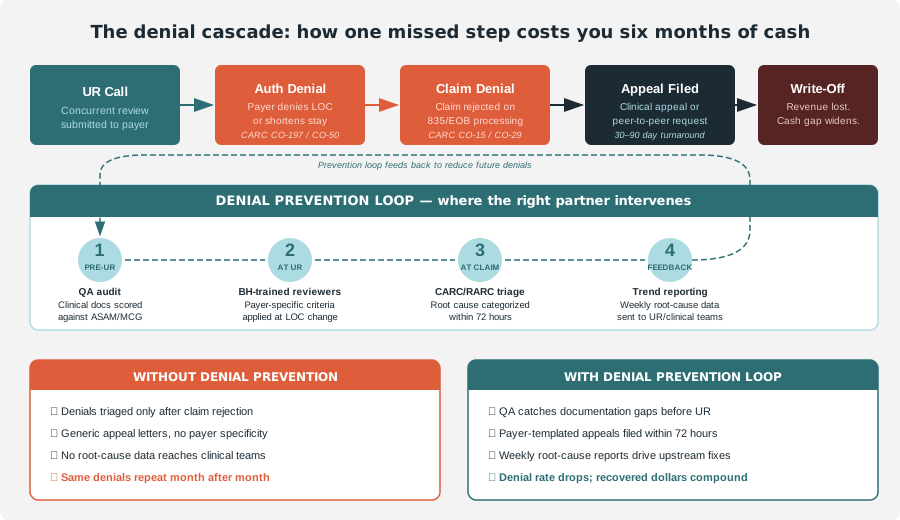
“The biggest thing we see is that denials in behavioral health don’t happen in isolation. They cascade,” says Brett Reed, chief operating officer at Prosperity Behavioral Health. “A documentation gap leads to an authorization denial, which leads to a claim denial, which leads to an appeal that takes 90 days. By the time you’re working the appeal, three more months of claims have stacked up behind it. You have to break the cycle upstream.”
FAQ
What’s a typical denial rate for behavioral health? Industry-wide, behavioral health providers see initial denial rates between 10–20%, depending on payer mix, level of care, and documentation quality. Authorization-related denials, especially for PHP and residential services, tend to be the largest category.
What’s the difference between denial management and denial prevention? Denial management is reactive: working denied claims through appeal and resubmission. Denial prevention is proactive: fixing the upstream issues (documentation gaps, authorization timing, coding errors) that cause denials in the first place. The most effective partners do both.
How much does denial management cost? It depends on the model. Full-service RCM partners typically charge 4–6% of total collections with denials included. Standalone denial specialists charge 15–30% of recovered dollars. Software platforms run $500–$3,000+/month in subscription fees, plus your staff time.
Can I outsource just denials and keep the rest of RCM in-house? Yes, but you’ll lose the prevention feedback loop. If your denial recovery vendor doesn’t have visibility into your UR decisions, eligibility verification, and coding practices, they can recover dollars but can’t stop the same denials from recurring.
How long does it take to recover an old denial? For claims under 120 days, expect 30–60 days for most appeals. For claims over 120 days, timelines stretch to 60–120 days and recovery rates drop significantly as you approach timely filing limits. The earlier a denial is worked, the higher the recovery probability.
How Prosperity approaches this
Prosperity Behavioral Health is a behavioral health–exclusive RCM partner. Our team works denial recovery and denial prevention as a single integrated function. The same data that drives our appeal strategy feeds back into our utilization review and QA processes to prevent recurrence. We deploy a proprietary technology platform alongside staff who work exclusively in behavioral health billing, and our clients see a 97%+ collection rate and 99.5% clean claim rate.
If you’re evaluating denial management services and want to understand how an integrated approach would work for your organization, talk to our team.
Related reading:
- Top reasons for behavioral health claim denials and how to prevent them
- Behavioral health utilization review
- Maximizing behavioral health revenue: expert support
- Behavioral health revenue cycle management