
For behavioral health practices, the intake process is far more than a routine administrative hurdle. It is the precise moment where clinical fit is determined and where long-term revenue viability is established or lost. So, if the entryway is jammed with manual processes or vague data, the entire practice suffers downstream.
Unfortunately, many providers’ patient intake processes rely heavily on fragmented, manual intake workflows that yield significant revenue leakage. This leakage manifests in three ways: patients leave your practice before admission, claims are denied due to eligibility errors and convoluted pricing, and staff experience burnout from chasing paperwork.
Fortunately, your behavioral health practice can launch a new era in your patient intake with some strategic moves. Optimizing this process is all about precision. Let’s explore how your practice can secure its bottom line while keeping the focus on patient care.
1. Standardize Verification of Benefits
Patients already face significant challenges in finding and accessing covered healthcare. Poorly managed Verification of Benefits (VOB) practices by providers can compound this issue, leading to avoidable errors. In fact, Promptly confirms that “registration and eligibility errors account for roughly 24% of all claim denials.”
Moreover, unlike standard medical care, where a copay is often a flat fee, behavioral health coverage can be uniquely complex due to each practice taking different approaches to treatment and varying coverage limits for different levels of care.
That’s why your team must take every precaution to ensure your VOB runs as smoothly and accurately as possible. To optimize this phase, implement a rigorous, standardized financial vetting process by:
- Adopting a “Financial Gateway” mindset. Behavioral health VOB requires a deeper dive than standard medical checks because plans often distinguish heavily between inpatient, residential, and outpatient coverage. Your team must specifically verify mental health riders, session limits, and other insurance technicalities before authorizing higher levels of care.
- Enforcing a protocol of standardized health data points. A VOB check should never be considered “complete” until specific, granular data points are entered into your system. Mandate that staff record exact figures for the deductible accumulated to date, the out-of-pocket maximum, and specific effective dates for mental health coverage to ensure every claim receives proper oversight.
- Prioritizing patient transparency with instant estimates. Surprise bills cause patient drop-off and debt, so use your software to generate a “patient responsibility estimate” instantly during intake. Ensuring families understand the financial commitment of long-term behavioral health treatment upfront builds trust and reduces accounts receivable issues later.
The key to VOB success is using the right practice management (PM) software. While manual phone calls are sometimes necessary for complex cases or obscure payers, your software should handle the heavy lifting first. Advanced PM software can automatically flag active or inactive status before a staff member picks up the phone, allowing your team to focus their manual efforts only on the exceptions that require human intervention.
2. Proactively Manage Utilization Review
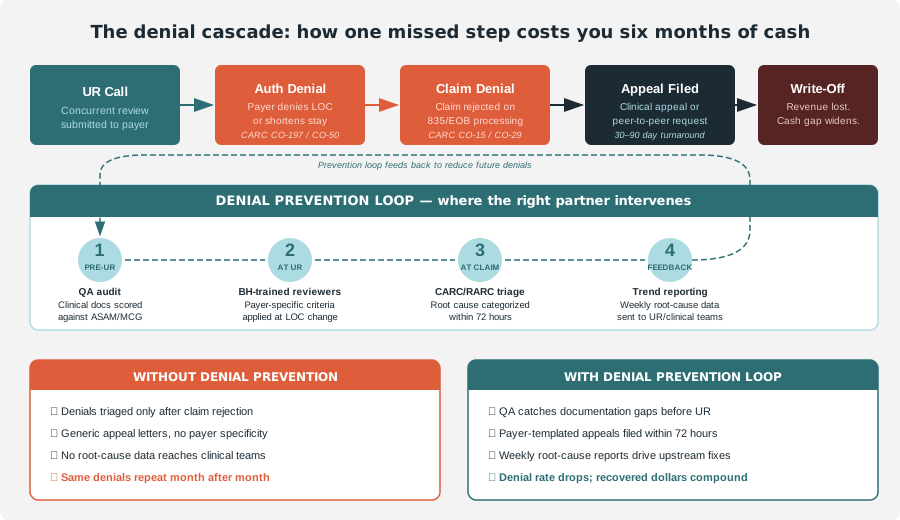
Utilization Review (UR) can cause friction between your clinical treatment plans and the insurance plan. For instance, the insurance carrier might argue for intensive outpatient care while your assessment indicates a need for inpatient treatment. In a non-optimized practice, this dialogue happens after admission, leading to inefficient, retroactive planning—but in an optimized practice, the UR strategy begins during the very first intake call.
Build a proactive and effective UR practice by:
- Training staff to speak insurance providers’ language. Insurance care managers often look for buzzwords that strengthen their cases. Your intake documentation must counter this by explicitly stating why lower levels of care are insufficient. Phrases like “history of failed outpatient treatment” should be captured during the very first touchpoint to improve results.
- Preventing “Gap Days.” A significant revenue leak in behavioral health is the “Gap Day”—days where a patient is under your care, but authorization has expired. Configure your PM software to trigger high-priority alerts 48 hours before an authorization ends.
- Building automated denial workflows. When a denial hits, don’t panic. Use your software to automatically trigger a notification to your medical director to schedule a follow-up call with the insurance company’s doctor. Having this workflow pre-built enables quick turnaround and improves the chances of coverage.
Your team should have standard guidelines about how to address insurance providers. Start with an insurance provider cheat sheet that maps common patient symptoms directly to required insurance terminology, and distribute it to your intake team.
3. Digitize and Centralize Patient Data Collection
In behavioral health, efficiency is a clinical tool. Asking a patient to recount their history multiple times to various team members wastes time and can negatively impact their therapeutic experience.
Digitizing intake is about creating a Single Source of Truth (SSOT). By moving away from disjointed paper forms and into a centralized digital ecosystem, you ensure that the patient’s story is told once, recorded accurately, and accessible to all relevant team members. Get started by:
- Implementing a mobile-first, discreet pre-admission process. Patients value privacy and ease. A mobile-friendly intake form allows them to input sensitive history from the privacy of their home. This approach reduces the pressure of filling out a clipboard in a lobby while in a vulnerable state of mind.
- Establishing a digital hub for your data. Demographic and clinical data entered during pre-screening should populate your PM and the billing software automatically. This frees up staff time and improves accuracy for coverage conversations.
- Using conditional logic on intake forms. A patient coming in for depression shouldn’t be forced to answer three pages of questions about unrelated medical concerns. Modern smart forms reduce abandonment rates and guarantee the clinical team gets exactly the data they need by dynamically tailoring questions to each patient in real-time.
- Spotting operational bottlenecks. The healthcare industry is well-known for its lengthy wait times. In fact, the average wait time for a physician visit is currently 31 days. Use your software’s dashboard to track the exact time between the “First Call” and “Admission.” If this number is creeping up, you have an operational bottleneck that is costing you admissions.
Strict data hygiene standards apply to healthcare organizations to prevent HIPAA violations; hoarding obsolete patient records creates a massive, unnecessary attack surface for hackers. By routinely purging stale data (about every six months), using secure software, and enforcing access only to relevant team members, you reduce your liability and protect patient privacy.
4. Outsource Patient Intake Logistics
The complexity of behavioral health billing has made Revenue Cycle Management (RCM) a specialized discipline. Trying to manage RCM, VOB, and UR in-house can distract providers from their core mission: treating patients.
Outsourcing critical patient intake processes to professionals can help you provide high-quality patient care and accurate, efficient front-office outcomes. Here are some specific benefits of outsourcing patient intake jobs:
- Time savings. Look at your leadership team’s calendar. How many hours are spent on billing disputes, credentialing issues, or software configuration? If you’re experiencing significant slowdowns that distract from patient care, look into outsourcing front-office intake work.
- Scalability. Managing in-house billing means growth often requires more administrative staff—for instance, hiring a new billing specialist for every 10 added beds. Outsourcing, however, provides an elastic infrastructure that scales with you. This allows you to increase patient volume and expand to new locations without the administrative burden of recruiting, training, and managing a larger team.
- Strategic collaboration. The most successful practices work with consultants rather than simply handing off tasks. This balanced relationship allows each team to capitalize on its strengths; for example, the internal team can focus on patient engagement, while the external partner can improve financial management. This partnership ensures that all aspects of the practice are addressed, and neither the clinical nor the financial side is neglected.
When vetting a consultant or contractor, ensure they specialize in solving your practice’s unique challenges and have a proven track record of implementing efficient intake process improvements. Look for this information via a combination of third-party reviews and sales materials, giving you a well-rounded dataset.
Optimal patient intake processes help you acquire new patients while making your staff members’ lives easier. It’s a win-win—you get to secure a loyal patient base and become a great place to work. If you’re looking for an expert to level up your operations, reach out to a proven leader (like Prosperity) that understands unique healthcare management challenges.